Back to all blogs
Learn what proxy candidates are, how proxy interviews work, the risks they create, how recruiters can detect them, and how companies can prevent interview fraud.

Remote hiring has made it possible for companies to interview candidates from almost anywhere in the world. But as hiring becomes more digital, organizations face a growing challenge: how do you know the person attending the interview is actually the person who applied for the job?
One form of interview fraud is the use of proxy candidates. A proxy candidate is a person who participates in an interview or assessment on behalf of another candidate. Instead of evaluating the applicant's actual skills and experience, the hiring team may unknowingly evaluate someone else's knowledge, communication ability, or technical expertise.
This is part of a broader interview-fraud problem. According to a Gartner survey, 6% of job candidates admitted to participating in interview fraud, including posing as someone else or having someone else pose as them. Gartner has also predicted that one in four candidate profiles could be fake by 2028, highlighting the growing importance of candidate authenticity in digital hiring.
For recruiters, this means interview integrity can no longer be treated as a minor operational issue. A fraudulent candidate can lead to a poor hire, increased recruitment costs, productivity problems, and, in technical or sensitive roles, potential security and data risks.
What Is a Proxy Candidate?
A proxy candidate is an individual who participates in an interview or assessment on behalf of the actual job applicant.
For example, suppose Candidate A applies for a software engineering position but does not have the technical expertise required for the role. Candidate B, who has stronger technical skills, attends the interview instead and answers the interviewer's questions while pretending to be Candidate A.
The interviewer may then believe that Candidate A has demonstrated the required skills and recommend them for the position.
This practice is commonly referred to as a proxy interview or candidate impersonation.
Proxy participation can occur during:
Initial screening interviews
Technical interviews
Coding rounds
Behavioral interviews
Online assessments
Managerial interviews
Final interview rounds
In some cases, another person completely replaces the candidate. In others, the candidate remains on camera while another person secretly provides answers through a second device, messaging application, hidden audio, or another communication channel.
In both cases, the core problem is the same: the hiring team is not independently evaluating the actual candidate.

What Is a Proxy Interview?
A proxy interview occurs when someone other than the actual applicant participates in the interview on the applicant's behalf. In some cases, the actual candidate may remain present but receive substantial assistance from another person during the interview. These behaviors may suggest that candidates are receiving external assistance or communicating with another person during the interview. While this is not a traditional proxy interview, it is another form of interview fraud that can undermine the accuracy of the hiring decision. According to BarRaiser, common red flags for proxy interviews include delayed responses, unusually long pauses, inconsistent explanations, and difficulty answering detailed follow-up questions.
There are several ways this can happen.
1. A Stand-In Candidate
This is the most straightforward form of proxy interviewing.
Another individual attends the interview and introduces themselves as the applicant. The proxy may study the candidate's resume, LinkedIn profile, previous projects, and job description before the interview.
The more experienced proxy then handles the interview while the actual candidate remains absent.
2. Hidden Human Assistance
The candidate may appear on camera, but another person helps them answer questions from outside the camera frame.
For example, a helper could:
Listen to the interview through another device
Send answers through chat
Provide technical solutions
Give verbal instructions through an earpiece
Help solve coding or system-design questions
In this situation, the candidate technically appears in the interview, but the performance being evaluated is not entirely their own.
3. Interview Swapping
Another variation occurs when different people participate at different stages of the hiring process.
For example, one person may clear the technical interview while another person later joins the organization.
This makes identity continuity across multiple hiring stages particularly important.
4. Proxy Interviews Combined With AI
Proxy interviews can also be combined with AI tools.
A candidate may use another person for some parts of the interview and AI-generated responses for others. They may also use real-time AI assistance while remaining visible on camera.
This creates a broader category that includes proxy candidates, AI interview assistants, deepfakes, identity manipulation, and other forms of unauthorized assistance. According to Phenom, citing Checkr, identity fraud moved into the top five hiring priorities for CHROs between 2025 and 2026.
Learn more about How Sherlock AI Prevents Proxy Interviews
Proxy Candidate vs. AI-Assisted Candidate vs. Deepfake Candidate
Type of Interview Fraud | What It Means | How It Works | Example | Detection Focus |
Proxy Candidate | Another person participates in the interview on behalf of the actual candidate. | A stand-in attends the interview and answers questions while pretending to be the applicant. | A candidate applies for a software engineering role, but a more experienced developer attends the technical interview for them. | Identity verification, behavioral patterns, candidate consistency, and liveness |
AI-Assisted Candidate | The actual candidate participates but receives unauthorized help from AI tools during the interview. | The candidate uses an AI tool, another device, or external application to generate or suggest answers in real time. | A candidate receives AI-generated solutions to coding or technical questions while appearing to solve them independently. | External application activity, unusual response patterns, answer timing, and behavioral signals |
Deepfake Candidate | AI-generated or manipulated video or audio is used to impersonate a candidate. | The candidate's face or voice is digitally altered, or synthetic media is used to make another person appear to be the applicant. | A proxy participant uses real-time face-swapping technology to appear as the candidate during a video interview. | Video and audio analysis, identity verification, liveness detection, and deepfake indicators |
Why Are Proxy Candidates Becoming a Bigger Hiring Risk?
Remote hiring has removed many of the natural identity checks that occur during face-to-face recruitment.
When interviews take place entirely online, recruiters may never physically meet the candidate before an offer is made. Candidates can participate from different locations, use different devices, and communicate through a wide range of digital tools.
At the same time, AI has made interview assistance easier. Modern interview fraud can involve proxy candidates, AI interview assistants, deepfake videos, voice manipulation, and real-time answer generation. These techniques are part of the broader landscape of AI interview fraud.
For a company conducting thousands of interviews, even a small percentage can translate into a meaningful number of fraudulent interview attempts.
1. Skills Mismatch
The most immediate risk is hiring someone who cannot perform at the level demonstrated during the interview.
A proxy candidate may answer technical, behavioral, or role-specific questions on behalf of the actual applicant. As a result, the interview performance may create a false impression of the candidate's knowledge and capabilities.
For example, a candidate may appear capable of solving complex coding problems because a proxy answered the questions during the technical interview. Once hired, the employee may struggle with tasks that should have been routine for the role.
This creates a gap between interview performance and actual job performance, making it difficult for the organization to rely on its hiring assessment.
2. Increased Hiring Costs
A fraudulent hire can be expensive.
Organizations may spend resources on recruiting, interviewing, background verification, onboarding, training, equipment, and managerial time before discovering that the employee does not have the capabilities demonstrated during the interview.
For example, a company may spend several weeks hiring a senior software developer, including multiple technical interviews and an extensive onboarding process. If the candidate later fails to perform at the expected level because someone else completed the interview, the company may have to spend additional resources finding and training a replacement.
This increases the overall cost of hiring and can force the organization to repeat a recruitment process that it believed had already been completed successfully.
3. Productivity Loss
When an employee does not have the skills they demonstrated during interviews, other team members may have to compensate.
The new employee may require more supervision, additional training, or continuous assistance from experienced colleagues. This can affect the productivity of the entire team rather than just the individual employee.
For example, a company may hire a developer who appeared capable of independently managing complex projects during the interview. After joining, the employee may require senior developers to review basic work, resolve errors, and provide regular guidance.
This can lead to missed deadlines, increased workloads, delayed projects, and reduced team productivity.
4. Security Risks
The security implications can be particularly serious for technical and high-access roles.
A candidate who successfully passes an interview may eventually receive access to sensitive company resources such as source code, internal applications, cloud infrastructure, customer information, financial systems, proprietary technology, and internal documentation.
For example, a company may hire a senior engineer after a proxy candidate demonstrates advanced knowledge during the interview. Once hired, the employee receives access to the organization's code repositories and cloud infrastructure. If the person hired is not the individual who actually demonstrated those skills during the interview, the company may have unknowingly introduced an additional security risk.
This is why interview fraud can become an enterprise security concern, not just an HR problem.
5. Damage to Hiring Integrity
Hiring depends on trust.
Recruiters need to trust that candidates are accurately representing their identities, qualifications, experience, and abilities throughout the recruitment process. Proxy interviews can undermine that trust by making it difficult to determine whether the person being evaluated is actually the person who applied.
For example, if a company regularly conducts remote interviews and discovers that candidates have been using proxy participants, recruiters may need to introduce additional identity checks and verification procedures for future applicants. This can make the hiring process longer and more complicated for both recruiters and genuine candidates.
This can ultimately damage the integrity and reliability of the entire recruitment process, particularly for organizations that depend heavily on remote interviews and high-volume technical hiring.

How Can Recruiters Identify Proxy Candidates?
There is no single behavior that proves someone is a proxy candidate.
A candidate may pause because they are nervous. Their camera may malfunction. Their voice may sound different because they are using another microphone. They may look away from the screen while thinking.
Therefore, recruiters should not make a fraud decision based on one isolated anomaly.
Instead, the stronger approach is to evaluate multiple signals together.
1. Check Identity Across Interview Stages
One of the most important controls is maintaining identity continuity.
Organizations can compare identity signals across:
Application
Candidate profile
Initial screening
Technical interview
Assessment
Final interview
Offer stage
Onboarding
If different people appear at different stages without a legitimate explanation, the organization should investigate further. Maintaining identity continuity across the hiring process makes it harder for candidates to use a proxy at one stage and appear themselves at another.
2. Ask Detailed Questions About the Resume
A proxy may know what is written on a candidate's resume but may not know the experiences behind it. According to GetReal Security, 41% of organizations have unknowingly hired a fraudulent candidate.
Recruiters can ask candidates to explain:
Why they selected a particular approach
What challenges they encountered
What decisions they personally made
What went wrong in a project
How they measured success
What they would do differently today
Candidates with genuine experience should generally be able to explain the reasoning, decisions, and context behind their work.
3. Ask Unexpected Follow-Up Questions
Predictable questions are easier to prepare for.
Unexpected follow-up questions can help recruiters understand whether the candidate genuinely understands the subject.
For example, instead of asking only:
"Tell me about your previous project."
An interviewer can ask:
"What was the most difficult technical decision you made?"
"What would break if you changed that architecture?"
"Why did you choose that approach over the alternative?"
"What was one mistake you made during the project?"
"How would you redesign it today?"
These questions require the candidate to reason from personal experience rather than repeat prepared answers.
4. Compare Interview Performance With the Resume
Recruiters can compare what candidates claim on their resume with how they perform during the interview and assessment.
For example, a candidate may claim extensive experience with a technology but struggle to explain basic implementation decisions.
Recruiters can look for:
Gaps between claimed and demonstrated skills
Inconsistent project details
Difficulty explaining personal contributions
Weak understanding of technologies listed on the resume
Differences between interview and assessment performance
One inconsistency is not necessarily suspicious. However, repeated inconsistencies across multiple stages can justify additional verification.
5. Look for Unusual Response Timing
Proxy candidates or candidates receiving external assistance may sometimes demonstrate unusual response patterns.
For example:
Long pauses before answering simple questions
Responses that appear delayed
Highly polished answers followed by weak follow-ups
Answers that do not directly address the question
Sudden changes in response quality
However, response timing should always be considered alongside other signals.
A pause is not proof of cheating.
6. Watch for Changes in Voice or Appearance
Significant or unexplained changes between interview rounds can warrant additional verification.
Recruiters may notice differences in:
Facial appearance
Voice characteristics
Speech patterns
Lighting
Camera quality
Background
Communication style
However, legitimate explanations are common. Candidates may use different devices, microphones, locations, or internet connections.
The important factor is whether several inconsistencies appear together.
7. Look for Suspicious Device or Environmental Activity
Proxy fraud can involve more than the person visible on the webcam.
Candidates may use:
Multiple devices
Hidden audio
Messaging applications
Remote connections
Additional screens
External collaborators
AI assistants
Some forms of external assistance may not be visible to the interviewer during a standard video call.
That is why modern interview integrity systems increasingly analyze device, environmental, behavioral, and identity signals rather than relying exclusively on the webcam.
How Can Companies Prevent Proxy Interviews?
Detection is important, but preventing proxy participation before it affects the hiring decision is even better.
1. Verify Candidate Identity
Organizations should establish an appropriate identity-verification process for roles where candidate fraud presents a meaningful risk.
Depending on the role, geography, and applicable requirements, this can include:
Government-issued ID verification
Live selfie verification
Liveness checks
Biometric verification
Candidate identity matching
The goal is to establish that the person participating in the interview is the person associated with the application.
2. Use Continuous Verification
Identity verification should not necessarily happen only once.
Organizations can introduce verification at important stages such as:
Initial screening
Technical assessment
Final interview
Offer stage
Onboarding
This makes it harder for a candidate to pass one stage and then use a proxy during another.
3. Use Live Skill Assessments
Identity verification tells you who the candidate is.
Skill assessments tell you what the candidate can actually do.
Organizations can use:
Live coding
Debugging exercises
System-design discussions
Case studies
Role-specific scenarios
Live problem-solving
The objective is to evaluate genuine capability instead of relying only on resume claims.
4. Train Interviewers
Recruiters and hiring managers should understand the different types of interview fraud.
Training should help interviewers recognize patterns involving:
Candidate identity
Behavioral inconsistencies
External assistance
AI-generated answers
Deepfake manipulation
Proxy participation
At the same time, interviewers should understand that individual anomalies are not automatically evidence of fraud.
5. Create an Escalation Process
Hiring teams should have a documented process for handling suspicious interviews.
For example:
Record the relevant signals.
Avoid making an immediate accusation.
Request additional verification when appropriate.
Escalate the case to the relevant recruiting or security team.
Review multiple sources of evidence.
Document the final decision.
This helps make candidate-fraud investigations more consistent and less subjective.
Read more about 15 Ways to Prevent Proxy Interviews Remotely
How Sherlock AI Helps To Detect Proxy Candidates?
Identifying proxy candidates manually can be difficult, particularly when another person is helping the candidate without appearing on camera. Traditional interview monitoring often focuses on what the recruiter can see and hear, while modern interview fraud can involve hidden devices, external collaborators, AI assistants, identity manipulation, or different people participating across interview stages.
1. Continuous Identity Verification
A candidate may pass an initial identity check and then attempt to replace themselves later. Sherlock AI uses continuous identity verification to help organizations assess whether the same candidate remains present throughout the interview.
This can help surface:
Candidate swaps
Identity inconsistencies
Proxy participation
Candidate impersonation
Changes between interview stages
The benefit is that identity becomes an ongoing part of interview integrity rather than a one-time checkpoint.
2. Behavioral and Interview Signal Analysis
Proxy candidates may behave differently from the actual applicant.
They may have different:
Response patterns
Communication styles
Engagement levels
Interaction behavior
Answer timing
Sherlock AI analyzes behavioral signals as part of a broader pattern rather than treating one unusual behavior as proof of fraud.
This is important because legitimate candidates can also behave differently depending on stress, internet quality, environment, or interview difficulty.
The objective is to give recruiters additional evidence, not replace human judgment.
3. Detecting External and AI-Assisted Interview Fraud
A candidate may remain visible on camera while receiving assistance through another person, device, messaging application, or AI tool.
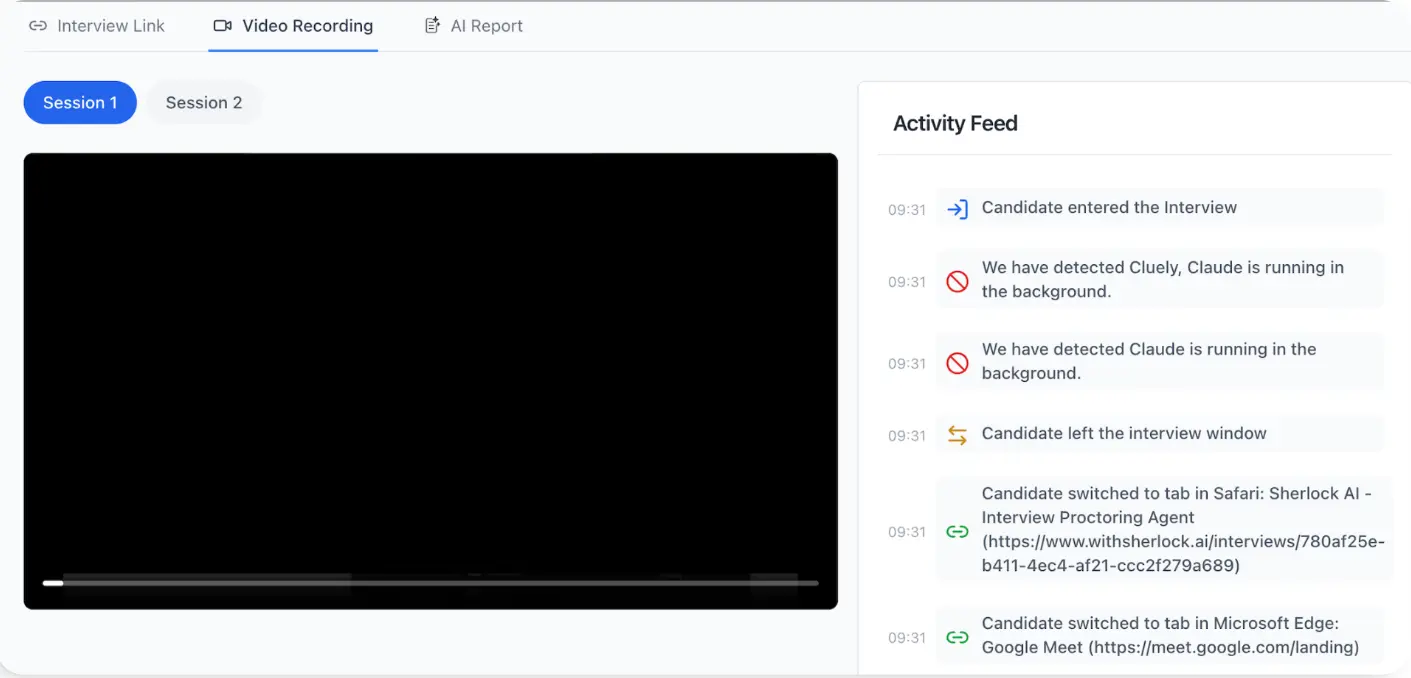
Sherlock AI is designed to analyze device, environmental, behavioral, and interview signals that can help surface suspicious activity that may not be obvious from the webcam alone. Its broader approach to candidate fraud detection can help identify patterns associated with:
Hidden human assistance
External answer generation
AI-assisted responses
Multiple devices
Off-camera assistance
This is particularly important as proxy participation and AI-assisted cheating can be combined within the same interview.
4. Detect Deepfakes and Candidate Impersonation
Proxy candidates are part of a broader candidate-impersonation problem. Modern hiring fraud can also involve deepfake video, voice manipulation, synthetic identities, or other forms of identity manipulation.
Sherlock AI can help organizations identify potential impersonation through signals such as:
Facial or identity inconsistencies
Voice-related anomalies
Video manipulation indicators
Identity mismatches across interview stages
Other signals associated with candidate impersonation
This helps hiring teams look beyond traditional proxy participation and identify other forms of identity-related interview fraud.
5. Combine Multiple Signals for Fraud Detection
No single signal can reliably establish that an interview is fraudulent. A candidate looking away from the screen, pausing before an answer, or using a different device may have a legitimate explanation.
Sherlock AI combines multiple signals across the interview, including:
Identity
Behavioral patterns
Audio and video
Device activity
Environmental signals
Cross-signal inconsistencies
By bringing these signals together, Sherlock AI can help recruiters identify interviews that may require additional verification rather than relying on a single red flag.
Conclusion
Proxy candidates create a fundamental challenge for remote hiring: companies may believe they are evaluating one person while actually assessing someone else.
As remote interviews and AI-assisted recruitment continue to evolve, organizations need stronger ways to establish candidate authenticity. Identity verification, continuous verification, live skill assessments, and multi-signal interview analysis can help hiring teams make decisions based on the candidate's actual identity and abilities.
The goal is not to make hiring more complicated or treat every candidate as suspicious. It is to ensure that the person who applies is the same person who interviews, demonstrates the required skills, and ultimately joins the organization.
Sherlock AI helps organizations strengthen interview integrity by combining identity verification, behavioral analysis, device and environmental signals, and interview-fraud detection to identify potential proxy participation, candidate impersonation, AI assistance, and other suspicious patterns.
When organizations can confidently connect a candidate's identity with their demonstrated skills, they can make more reliable hiring decisions and build a recruitment process that candidates and employers can trust.
Protect Your Interviews From Proxy Candidates See how Sherlock AI helps detect proxy candidates, identity inconsistencies, AI-assisted cheating, and other forms of interview fraud. |
|---|
FAQs
1. What is a proxy candidate in an interview?
A proxy candidate is a person who participates in an interview or assessment on behalf of another job applicant. The proxy may completely replace the applicant or provide hidden assistance during the interview.
2. What is the difference between a proxy candidate and an AI-assisted candidate?
In a proxy interview, another person participates in or helps conduct the interview for the candidate. In AI-assisted cheating, the candidate may use an AI tool to generate or improve answers. These can also be combined as part of a larger interview-fraud attempt.
3. How can recruiters detect proxy candidates?
Recruiters can look for patterns across identity, behavior, response timing, resume knowledge, voice, appearance, device activity, and performance across multiple interview stages. No single signal should automatically be considered proof of fraud.
4. Why are proxy interviews a problem for companies?
Proxy interviews can result in companies hiring people whose actual skills do not match their interview performance. This can lead to poor productivity, additional hiring costs, security risks, and loss of confidence in the recruitment process.
5. How can companies prevent proxy interviews?
Companies can use identity verification, continuous verification, live skill assessments, unexpected follow-up questions, interviewer training, documented escalation procedures, and AI-powered interview-fraud detection to reduce the risk of proxy participation.
6. Can Sherlock AI detect proxy interviews?
Sherlock AI is designed to identify proxy interviews and broader candidate-fraud patterns using multiple signals, including identity, behavioral, device, audio, video, and interview activity. It can help hiring teams surface suspicious patterns that require additional review.