Back to all blogs
Learn remote hiring compliance in India, including Labour Codes, DPDP, POSH, identity verification, background checks, and candidate fraud.

Abhishek Kaushik

Remote hiring in India allows companies to access talent beyond the location of their offices, but hiring someone remotely does not remove the employer's legal and compliance responsibilities. An employee's work location, employment classification, applicable labour requirements, data protection obligations, and state-specific rules can all affect how a remote hire should be handled.
The recruitment process also creates its own compliance considerations. Employers may collect resumes and identity information, conduct video interviews, record assessments, use background verification providers, and rely on AI-powered recruitment tools. At the same time, remote interviews can introduce risks such as proxy candidates, identity mismatches, deepfakes, and unauthorized AI assistance.
For employers, remote hiring compliance in India therefore goes beyond issuing an offer letter or allowing an employee to work from home. It requires a structured approach to employment documentation, candidate data protection, background verification, interview practices, identity verification, workplace conduct, and applicable state-specific requirements.
This guide explains the key remote hiring compliance requirements in India and provides practical steps employers can use to build a more consistent, secure, and compliant remote recruitment process.
Disclaimer: This article provides general information and is not legal advice. Companies should obtain professional legal advice for requirements that apply to their specific workforce, industry, establishment, and locations.
What Is Remote Hiring Compliance in India?
Remote hiring compliance refers to the legal and employment requirements employers need to consider when hiring and managing employees who work remotely. In India, applicable requirements can depend on factors such as the employee’s work location, employment arrangement, and the nature of the organization.
Key areas of remote hiring compliance include:
Employment Contracts: Clearly define the employee’s role, compensation, work location, working hours, leave, and other applicable terms and conditions.
Wages and Salary Payments: Ensure employees receive applicable wages and salary payments in accordance with relevant employment requirements.
Working Hours and Leave: Follow applicable rules and organizational policies related to working hours, holidays, overtime, and leave.
Employee Benefits: Provide applicable benefits and statutory contributions based on the employee’s eligibility and employment arrangement.
Data Protection: Protect employee and company data when employees access organizational systems and information remotely.
State-Specific Requirements: Check applicable state-level employment requirements based on where the employee works, particularly when employees relocate to another state.
Read more about - Securing Remote Interviews Against AI Assistance with Sherlock AI
Why Is Remote Hiring Compliance in India Important?
Remote hiring can help companies access a wider talent pool and streamline recruitment, but it also introduces legal, operational, privacy, and security considerations. A structured compliance process helps employers protect candidate information, maintain consistent hiring practices, meet applicable employment requirements, and reduce recruitment risks.
1. Protect Candidate and Employee Information
Remote recruitment involves the collection and processing of personal information through applications, interviews, assessments, background checks, and onboarding systems. Clear data-handling practices can help organizations control access to this information and reduce unnecessary privacy and security risks.
2. Maintain Consistent Hiring Practices
Candidates should be evaluated using consistent, job-related criteria regardless of where they are located or how the interview is conducted. Standardized recruitment procedures can help reduce inconsistent decision-making and create a clearer record of how hiring decisions were made.
3. Reduce Identity and Recruitment Fraud
Remote recruitment can make it easier for proxy candidates, identity mismatches, deepfakes, or unauthorized assistance to go unnoticed. Appropriate identity verification and interview controls can help employers confirm that the person being evaluated is the candidate who applied and reduce the risk of hiring based on a misrepresented identity or skill set.
4. Meet Employment and State-Specific Requirements
Remote employees may work from locations different from the employer’s headquarters. Depending on factors such as the employee’s location, employment arrangement, and the nature of the organization, different employment and state-level requirements may need to be considered.
5. Manage Third-Party Recruitment Risks
Companies often rely on applicant tracking systems, assessment platforms, background verification providers, video-conferencing tools, and other recruitment vendors. Employers should understand how these providers handle candidate information and establish appropriate contractual, security, access, and retention controls.
6. Support Better Hiring Decisions
Compliance should not be treated only as a legal exercise. Documented processes, appropriate verification, standardized evaluation criteria, and human oversight can help hiring teams make decisions based on reliable candidate information rather than incomplete or misleading signals.
What Are the Remote Hiring Compliance Laws in India?
India does not have a single law that governs all aspects of remote hiring. Instead, employers need to consider the employment, labour, data protection, workplace conduct, and state-specific requirements that apply to their organization and employees.
For remote employees, the applicable requirements can depend on factors such as the employee's work location, employment arrangement, industry, employer's establishment, and the nature of the work.
As of 2026, the four Labour Codes form the central framework for several areas of employment regulation in India. The Government of India announced that the four Codes came into force on November 21, 2025, consolidating 29 existing central labour laws.
1. Code on Wages, 2019
The Code on Wages, 2019, covers areas relating to wages, payment of wages, minimum wages, and related employment requirements.
For remote hiring, employers should ensure that working remotely does not result in non-compliance with applicable wage requirements. Employment agreements should clearly document compensation and relevant payment terms.
2. Code on Social Security, 2020
The Code on Social Security, 2020, consolidates provisions relating to social security and benefits, subject to applicable coverage and conditions.
Depending on factors such as the employee's employment arrangement, the employer's establishment, and applicable thresholds, employers may need to address statutory contributions and benefits as part of the employment relationship.
3. Occupational Safety, Health and Working Conditions Code, 2020
The Occupational Safety, Health and Working Conditions Code, 2020, addresses occupational safety, health, and working conditions.
Remote work does not automatically remove employment-related obligations. Employers should clearly define the remote working arrangement, working conditions, responsibilities, and applicable workplace policies based on the nature of the role and the requirements that apply to the organization.
4. Industrial Relations Code, 2020
The Industrial Relations Code, 2020, covers areas such as industrial relations, trade unions, and employment-related processes.
Its relevance to remote employees can arise in areas such as employment conditions, workplace policies, disputes, disciplinary processes, and other matters governed by the Code.
5. State-Specific Employment Requirements
Remote employees may work from a state different from the employer's headquarters or registered establishment. This can create additional compliance considerations because state-specific employment requirements may apply depending on the circumstances.
Employers should identify the employee's approved work location and review applicable state requirements, including provisions relating to working hours, leave, holidays, conditions of employment, and Shops and Establishments requirements where applicable.
Companies hiring employees across multiple states should avoid assuming that a single workplace policy automatically satisfies every state-specific requirement.
6. Digital Personal Data Protection Act, 2023
Remote recruitment and onboarding involve the collection and processing of digital personal data, including candidate and employee information.
The Digital Personal Data Protection Act, 2023, establishes a framework for processing digital personal data in India. The Digital Personal Data Protection Rules, 2025, were notified by the Ministry of Electronics and Information Technology in November 2025, with implementation following the commencement schedule specified in the notification.
For remote hiring, employers should review how candidate and employee information is collected, accessed, stored, shared with vendors, and protected across recruitment and onboarding systems.
7. Workplace Conduct and POSH Requirements
Remote hiring and employment can also involve workplace conduct obligations, including requirements under the Sexual Harassment of Women at Workplace Act, 2013.
Organizations should ensure that applicable workplace conduct policies and complaint mechanisms cover relevant digital and remote interactions, including video meetings, messaging platforms, email, and other work-related communication channels.
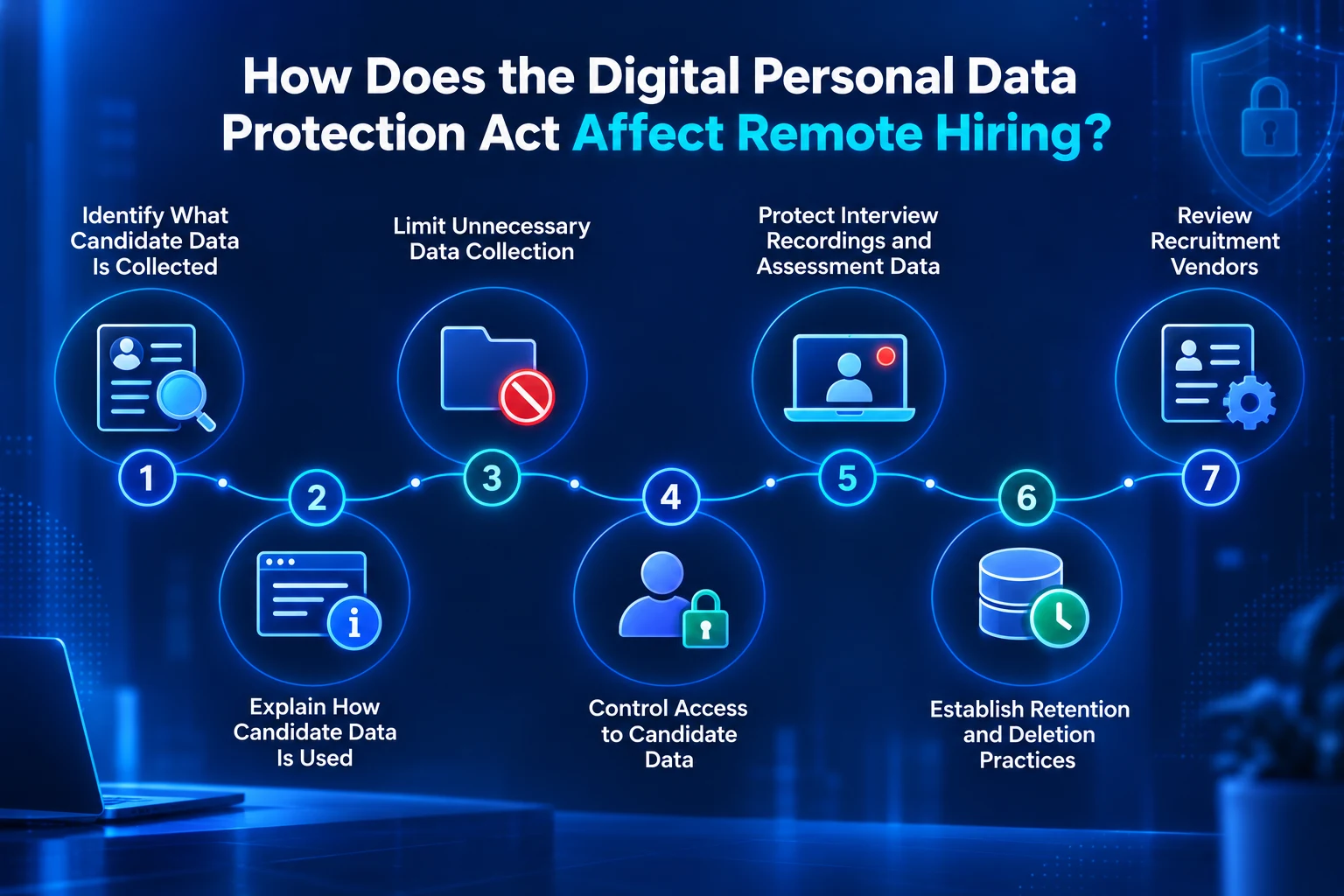
How Does the Digital Personal Data Protection Act Affect Remote Hiring?
Remote recruitment involves collecting and processing significant amounts of digital personal data. This can include candidate contact details, resumes, employment history, assessment results, interview recordings, identity information, and background verification records.
The Digital Personal Data Protection Act, 2023 establishes a framework for processing digital personal data in India. Employers should also consider the applicable commencement timeline and the Digital Personal Data Protection Rules, 2025 when reviewing their recruitment and onboarding processes.
For organizations hiring remotely, data protection should be considered across the entire candidate lifecycle, from application and screening through interviews, verification, and onboarding.
1. Identify What Candidate Data Is Collected
Employers should identify the types of personal data collected at each stage of recruitment and understand why the information is needed.
This may include:
Name and contact information
Resume and employment history
Educational qualifications
Assessment results
Interview recordings
Identity information
Background verification information
Information collected during digital onboarding
Creating a candidate data inventory can help organizations understand where recruitment information is collected and processed.
2. Explain How Candidate Data Is Used
Recruitment teams should provide candidates with clear information about how their personal data is handled where required under the applicable data protection framework.
Privacy notices and candidate communications should explain relevant purposes in clear language rather than using unnecessarily broad or vague descriptions.
3. Limit Unnecessary Data Collection
Employers should evaluate whether each category of candidate information is necessary for the recruitment process.
For example, information required during onboarding may not need to be collected during the initial application. Limiting unnecessary collection can reduce both privacy exposure and the amount of information the organization needs to secure and manage.
4. Control Access to Candidate Data
Candidate information should only be accessible to people who need it for their role in the recruitment process.
Organizations should establish appropriate access controls for recruiters, hiring managers, HR teams, background verification providers, assessment vendors, and other parties that may process candidate information.
5. Protect Interview Recordings and Assessment Data
Remote interviews and online assessments can generate sensitive recruitment information, including video, audio, candidate responses, and evaluation records.
Employers should establish clear practices for storing, accessing, reviewing, retaining, and deleting this information. Where third-party platforms process recordings or assessment data, organizations should also understand how those providers handle the information.
6. Establish Retention and Deletion Practices
Recruitment information should not be retained indefinitely without a legitimate reason.
Employers should establish appropriate retention periods for applications, interview recordings, assessment results, background verification reports, and other recruitment records based on applicable legal, contractual, business, and operational requirements.
7. Review Recruitment Vendors
Remote hiring often involves multiple third-party platforms, including applicant tracking systems, video interview tools, assessment providers, and background verification companies.
Before sharing candidate information with these vendors, employers should review relevant contractual arrangements, security practices, access controls, data handling procedures, and retention practices.
A documented approach can help organizations maintain better control over candidate data throughout the recruitment lifecycle.
What Should Employers Verify Before Hiring a Remote Employee?
Before hiring a remote employee, employers should verify the key employment, operational, and security factors that may affect the hiring relationship. Remote work can involve different requirements depending on the employee's work location, employment arrangement, role, and access to company systems or information.
Rather than treating every remote hire the same way, employers should establish a consistent pre-hire verification process that covers the following areas.
1. Employee's Work Location
Before hiring, confirm where the employee will actually perform their work. The work location can affect applicable employment requirements, taxes, registrations, and state-specific rules.
These may include:
State or location where the employee will work
Permanent or temporary remote-work location
Planned relocation after joining
Applicable state employment requirements
Employer registration or tax obligations, where applicable
Confirming the work location early helps employers identify location-specific requirements before the employee starts.
2. Employment Classification and Applicable Benefits
Before hiring, determine how the individual will be engaged and which employment requirements apply. Classification can affect compensation, benefits, contributions, and other employer obligations.
These may include:
Employee, consultant, or contractor classification
Applicable employment terms
Statutory benefits
Employer contributions, where applicable
Eligibility for company-provided benefits
A clear classification helps ensure the appropriate employment terms and obligations are addressed from the beginning.
3. Salary and Working Conditions
Before making an offer, confirm the compensation structure and key working conditions. These may include:
Salary and payment schedule
Working hours and expected availability
Leave and holidays
Overtime or additional working arrangements, where applicable
Performance and reporting expectations
Remote work should not be used as a reason to overlook applicable employment requirements or agreed working conditions.
4. Employment Agreement and Remote-Work Policy
Before the employee begins working remotely, clearly document the terms of employment and expectations for remote work.
These may include:
Job role and responsibilities
Permitted work location
Working hours and availability
Reporting structure
Company equipment and software
Remote-work expenses
Confidentiality and data security
Conditions for changing the approved work location
Clear documentation helps both the employer and employee understand their responsibilities before remote work begins.
5. Workplace and POSH Compliance
Before onboarding a remote employee, ensure that applicable workplace conduct and prevention of sexual harassment requirements are addressed.
These may include:
Workplace conduct policies
POSH policy and applicable requirements
Reporting and complaint mechanisms
Employee awareness and training
Standards for virtual meetings and digital communication
Remote work does not eliminate workplace conduct obligations, so employees should understand the applicable policies and reporting processes.
6. Background and Employment Verification
Before hiring, determine which background and employment checks are appropriate for the role. Employers should avoid applying unnecessary checks while ensuring relevant qualifications and employment information are verified.
These may include:
Previous employment
Educational qualifications
Professional credentials
References
Role-relevant background information
Employers should use a consistent verification process, protect verification data, and review discrepancies fairly.
7. Identity Verification
Before completing the hiring process, verify that the person participating in recruitment is the same individual who will ultimately join the organization.
These may include:
Identity verification during recruitment
Candidate verification during interviews
Verification during assessments
Identity checks during onboarding
Additional verification for sensitive roles or systems
Appropriate identity verification can help reduce the risk of impersonation, proxy candidates, and unauthorized access.
8. Equipment and Remote-Work Arrangements
Before the employee starts working remotely, confirm that they have the equipment, software, and resources required to perform their role securely.
These may include:
Company-provided laptop or work devices
Required software and applications
Security tools
Internet or connectivity support
Other approved equipment or expenses
Clear equipment and security expectations help employees work effectively while protecting company systems and information.
9. Working Hours and Availability
Before the employee starts, clearly establish their expected working hours, availability, communication requirements, and leave procedures.
These may include:
Expected working hours
Core availability periods
Meeting and communication expectations
Time-zone requirements
Leave and absence procedures
Clearly defined working arrangements help employers manage operational, employment, and communication requirements for remote employees.
Also Read: Top 12 Candidate Fraud and Identity Verification Tools to Consider in 2026
How Does Candidate Identity Verification Fit Into Remote Hiring?
Remote hiring can make it harder for employers to confirm that the person applying, interviewing, completing assessments, and joining the company is the same individual. Identity verification can help reduce risks such as proxy interviews, impersonation, identity mismatches, and deepfake manipulation.
A practical approach is to verify identity at the points where the risk is highest rather than treating verification as a single one-time check.
Hiring Stage | Identity Risk | What Employers Can Consider |
|---|---|---|
Application | Incorrect or misleading candidate information | Establish a basic identity baseline using appropriate candidate information. |
Remote Interview | Proxy candidates or impersonation | Confirm that the person attending the interview corresponds to the applicant. |
Online Assessment | Another person completing the assessment | Use appropriate controls to establish candidate continuity during important evaluations. |
Final Interview | Identity mismatch across interview stages | Reconfirm identity where appropriate, particularly for higher-risk roles. |
Onboarding | Different person joining than the person evaluated | Match the individual joining the organization with the candidate who completed the hiring process. |
A well-designed identity verification process helps employers reduce impersonation and proxy-candidate risks while keeping the remote hiring experience fair for legitimate candidates. By establishing appropriate verification points throughout recruitment and combining technology with human review, organizations can build greater confidence that the candidate evaluated is the person ultimately hired.
Also Read: How to Prevent AI-Based Candidate Impersonation in Interviews?
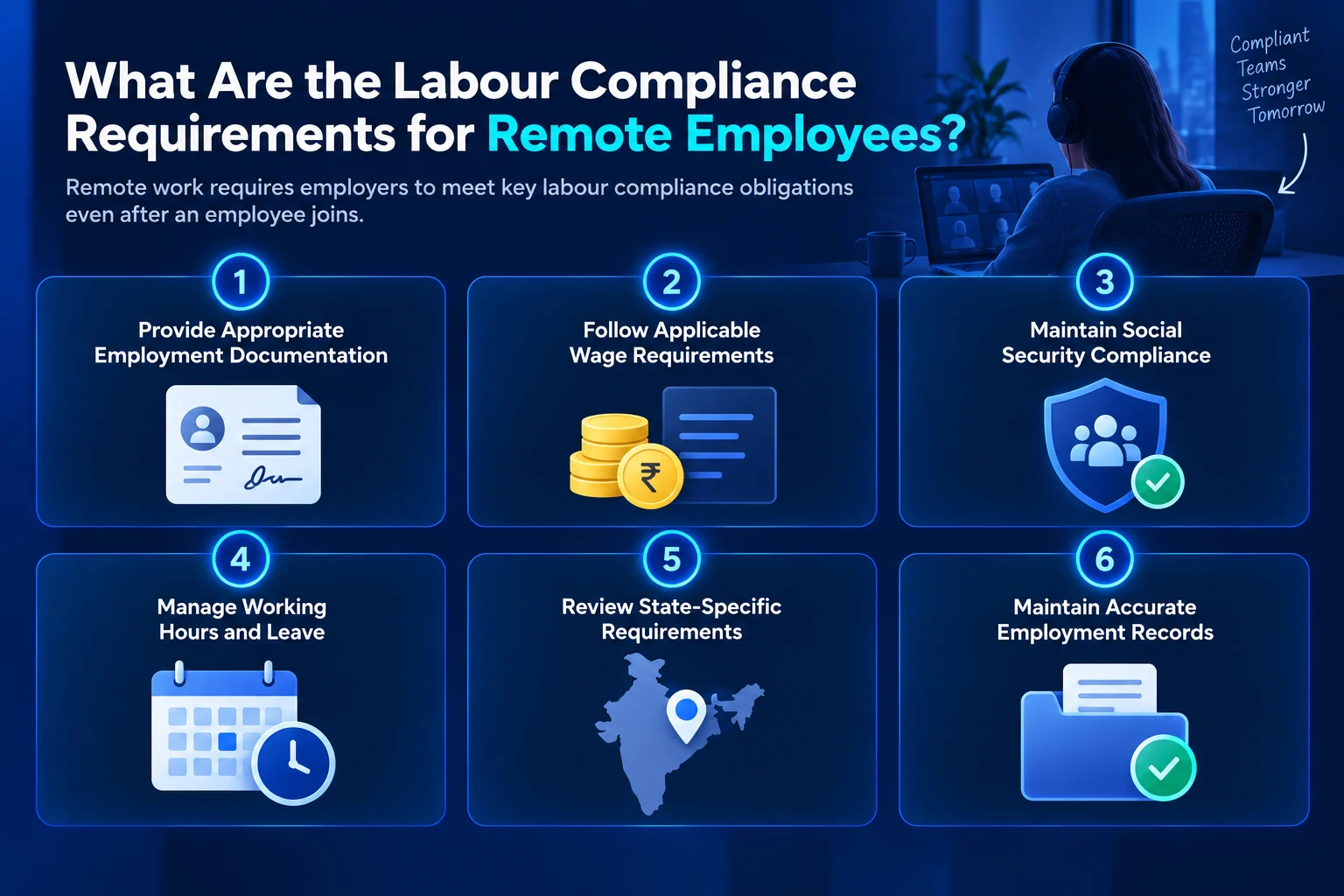
What Are the Labour Compliance Requirements for Remote Employees?
Remote hiring compliance does not end when a candidate accepts an offer. Once a remote employee joins, employers need to continue meeting applicable requirements relating to employment documentation, wages, social security, working conditions, and state-specific employment rules.
1. Provide Appropriate Employment Documentation
Employees should receive the documentation required for their employment relationship and applicable legal obligations. This may include an appointment letter, employment agreement, and other relevant employment documents.
2. Follow Applicable Wage Requirements
Employers should structure compensation according to applicable wage requirements and the terms agreed upon with the employee. They should also consider whether the employee's classification, location, or nature of work affects the requirements that apply.
3. Maintain Social Security Compliance
Where statutory social security obligations apply, employers should maintain appropriate registration, contribution, and recordkeeping processes. The specific requirements may depend on factors such as employee classification, remuneration, establishment, and eligibility.
4. Manage Working Hours and Leave
Employers should establish clear expectations around working hours, availability, holidays, and leave for remote employees. These arrangements should be consistent with the employee's employment terms and applicable requirements.
5. Review State-Specific Requirements
Remote employees may work from a state different from the employer's main office or establishment. Employers should therefore review applicable state-level requirements that may affect working hours, leave, working conditions, or other employment matters.
6. Maintain Accurate Employment Records
Employers should maintain appropriate records throughout the employment relationship, including relevant information relating to compensation, leave, statutory contributions, and employment documentation. Accurate records can also help demonstrate that remote employees are being managed consistently with applicable requirements.
How to Build and Ensure a Remote Hiring Compliance Policy?
A remote hiring compliance policy turns legal and operational requirements into a clear process that HR and hiring teams can follow consistently. Instead of reviewing requirements differently for every hire, employers can establish a standard approach for managing work locations, employment documentation, payroll, data protection, and state-specific requirements.
1. Create a Standard Hiring Checklist
Develop a practical checklist covering the key compliance steps that should be completed before a remote employee joins. This can include confirming the employee's work location, reviewing applicable employment requirements, completing required statutory formalities, and ensuring that employment documentation is in place.
2. Keep State-Specific Requirements Updated
When hiring employees who work from different states, maintain an updated record of the state-specific requirements that may apply. This helps HR teams identify whether a remote hire requires additional steps based on where the employee will work.
3. Train HR and Hiring Managers
Everyone involved in remote hiring should understand the organization's compliance process and know when additional review or advice may be required. Practical training can help HR teams and hiring managers handle situations such as hiring in a new state or an employee changing their approved work location.
4. Review and Update the Policy
Remote hiring policies should be reviewed periodically because employment requirements, state-level rules, technology, and internal processes can change. Regular reviews also provide an opportunity to address gaps identified during previous hiring activities.
5. Keep Proper Records
Maintain records showing that required hiring checks and compliance steps were completed. Employment agreements, work-location details, payroll records, verification records, and other relevant documents should be organized and accessible to the appropriate teams.
A well-maintained policy gives HR and hiring teams a consistent framework to follow while reducing the risk of important compliance steps being missed during remote recruitment.
What Should a Remote Hiring Compliance Checklist Include?
A remote hiring compliance checklist helps HR and hiring teams apply the organization's compliance process consistently across the recruitment lifecycle. It can be used before, during, and after hiring to make sure important employment, privacy, verification, and recruitment-integrity requirements are not overlooked.
Recruitment Compliance
☐ Use accurate and job-relevant job descriptions
☐ Apply consistent candidate evaluation criteria
☐ Follow a documented recruitment workflow
☐ Provide candidates with clear and appropriate communication
☐ Keep selection criteria focused on the requirements of the role
Candidate Data Protection
☐ Identify the candidate information being collected
☐ Provide appropriate information about how candidate data is handled
☐ Restrict access to candidate information to authorized personnel
☐ Review third-party recruitment and verification vendors
☐ Establish appropriate retention and deletion practices
☐ Secure interview recordings and assessment information
Remote Interview Compliance
☐ Use consistent interview procedures
☐ Provide candidates with clear interview instructions
☐ Define when and how interviews may be recorded
☐ Train recruiters and interviewers on the relevant process
☐ Maintain human review for important hiring decisions
Background and Employment Verification
☐ Define verification requirements based on the role
☐ Obtain appropriate candidate authorization where required
☐ Use reliable verification sources
☐ Protect verification information
☐ Apply a consistent process when reviewing discrepancies
Candidate Identity Verification
☐ Establish an appropriate identity baseline
☐ Maintain identity continuity across relevant hiring stages
☐ Consider controls for proxy candidates
☐ Review potential deepfake or synthetic-media risks where appropriate
☐ Investigate flagged cases through human review
Employment Compliance
☐ Provide appropriate employment documentation
☐ Review applicable wage requirements
☐ Complete applicable social security requirements
☐ Define working hours, leave, and other working conditions
☐ Confirm the employee's approved work location
State-Specific Compliance
☐ Confirm where the employee will work
☐ Review applicable state-level employment requirements
☐ Check relevant Shops and Establishments requirements
☐ Review state-specific working-hour or leave provisions where applicable
☐ Determine whether any local registration or establishment requirements apply
A checklist should be reviewed and updated periodically as hiring practices, employee work locations, technology, and applicable requirements change. Used consistently, it can turn remote hiring compliance from a collection of individual checks into a repeatable process for HR and hiring teams.
Why Is a Clear Remote-Work Agreement Important?
A clear remote-work agreement gives both the employer and employee a shared understanding of how the employment relationship will operate outside a traditional office. It can define important expectations around working hours, availability, performance, equipment, expenses, confidentiality, data security, and communication.
For employers hiring remote employees across different states, documenting the employee's approved work location is particularly important because applicable employment requirements may vary depending on the circumstances. The agreement should clearly state where the employee is permitted to work and whether prior approval is required before changing that location.
The agreement should also reflect the organization's broader remote-work and employment policies. When an employee relocates, changes their working arrangement, or takes on different responsibilities, employers should review whether the existing agreement or related records need to be updated.
A well-defined remote-work agreement reduces ambiguity, creates clear expectations, and helps employers manage remote working arrangements more consistently throughout the employment relationship.
Conclusion
Remote hiring in India offers employers access to a wider talent pool, but it also requires a structured approach to compliance. From employment documentation and state-specific requirements to candidate data protection, identity verification, workplace conduct, and responsible use of AI, each part of the hiring process can introduce different compliance considerations.
A clear remote hiring compliance policy helps organizations manage these requirements consistently. By standardizing hiring processes, protecting candidate information, verifying candidate identities, maintaining appropriate records, and keeping human oversight in important decisions, employers can reduce both compliance and recruitment risks.
As remote hiring continues to evolve, organizations should regularly review their policies, processes, and technology to keep them aligned with applicable requirements and emerging risks. The goal is not simply to make remote hiring compliant, but to create a consistent, secure, and trustworthy hiring process for both employers and candidates.