Back to all blogs
Traditional interviews often fail to predict real job performance. Learn the key hiring challenges, from weak signals to interview manipulation, and what modern hiring needs instead.

Interviews remain one of the most widely used tools in hiring. The logic seems straightforward: ask the right questions, evaluate the answers, and determine whether a candidate can succeed in the role. But there is a growing problem with this approach. A strong interview performance does not always provide a strong signal of actual ability.
Interviews often rely on short conversations, self-reported experiences, hypothetical scenarios, and a candidate's ability to communicate under pressure. These can provide useful information, but they do not always show how someone thinks, solves problems, makes decisions, or performs when faced with real work.
At the same time, recruiters are under increasing pressure to assess candidates accurately. LinkedIn's 2025 Future of Recruiting research found that 93% of talent acquisition professionals believe accurately assessing candidate skills is crucial to improving quality of hire. Yet only 25% said they were highly confident in their organization's ability to measure quality of hire effectively.
This creates a fundamental problem:
Hiring decisions depend on the quality of the signals produced during evaluation. If those signals are incomplete, rehearsed, or difficult to verify, even a well-run interview process can lead to the wrong conclusion. The issue is not that interviews have no value. Structured interviews can be useful and have stronger predictive validity than unstructured interviews. Research has consistently shown that interview structure matters.
The real question is whether today's interview process is capturing enough evidence to make a confident hiring decision.
As interview preparation becomes more sophisticated and AI becomes increasingly involved on both sides of the hiring process, that question matters more than ever.
To understand why traditional interviews are struggling, we need to look at what interviews are designed to measure, what they actually measure, and where the gap between the two comes from.
What interviews claim vs what they actually measure
Interviews are one of the most trusted tools in hiring. The assumption is simple: put a candidate in front of an interviewer, ask the right questions, and you’ll understand how capable they are.
That assumption breaks down quickly in practice.
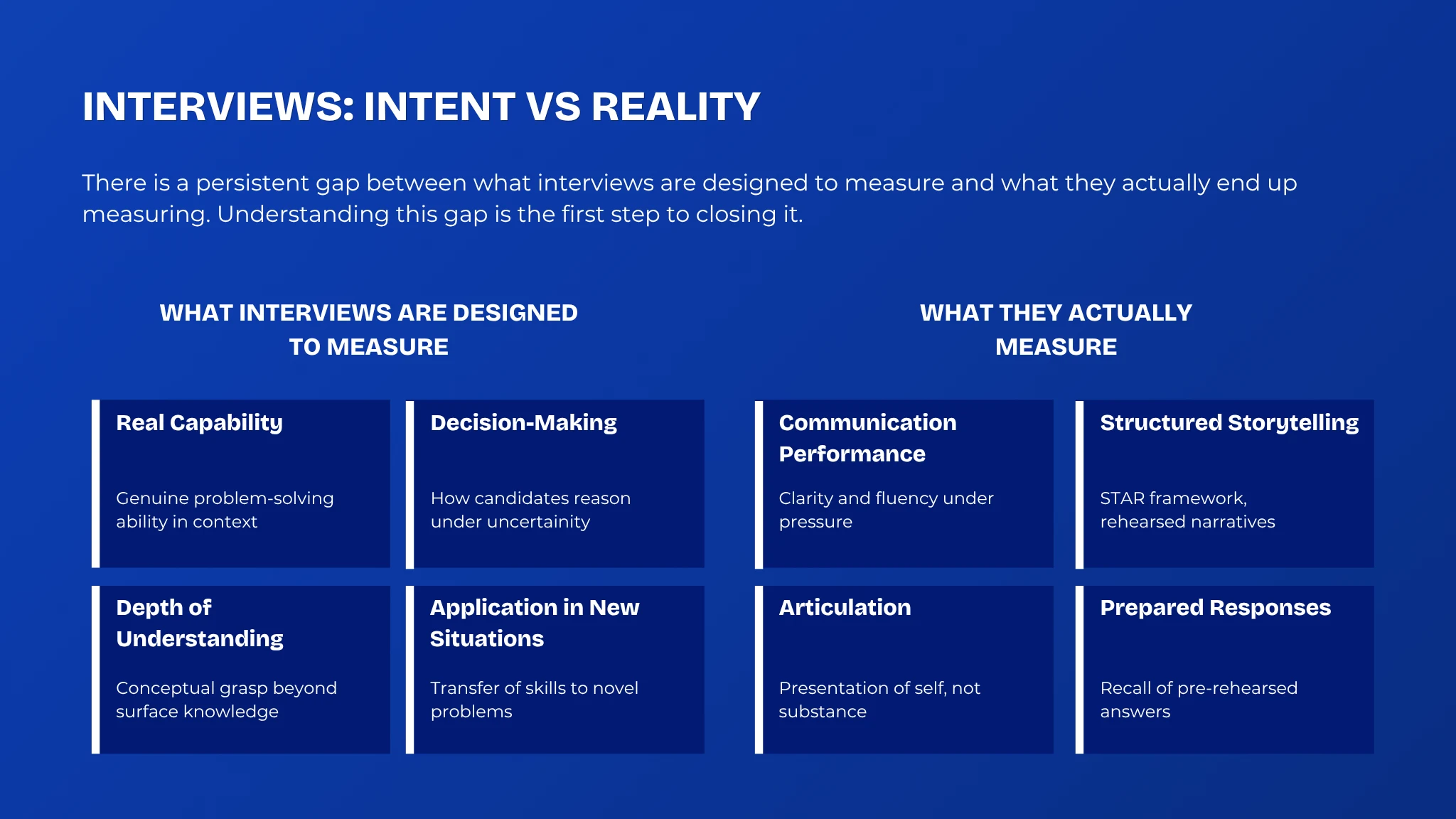
At their core, interviews are designed to evaluate how someone thinks. Can they break down problems? Do they make sound decisions? Can they apply their knowledge in unfamiliar situations? These are hard, nuanced traits. They require observation over time and across different contexts.
A typical interview does not provide that.
Instead, it compresses evaluation into a short, high-pressure conversation. And in that setting, the easiest thing to assess is not capability, but communication.
The original purpose: evaluating real ability
In theory, interviews are meant to simulate aspects of the job. A coding round is supposed to reflect problem-solving ability. A behavioral round is meant to uncover judgment and past decision-making. Case studies are designed to test structured thinking.
But most of these formats rely on one thing: the candidate’s ability to explain.
You are not watching them do the work in a natural environment. You are asking them to describe how they would do it, or how they did it in the past. That shift matters.
Describing work and actually doing it are very different skills.
What actually gets measured
Over time, interviews start to favor candidates who are good at:
Speaking clearly under pressure
Structuring answers in familiar formats (STAR, frameworks, etc.)
Highlighting impact and ownership convincingly
Reading the interviewer and adjusting responses in real time
None of these are inherently bad. In fact, they are useful skills in many roles.
The problem is when they become the primary signal.
A candidate who is highly capable but less polished can struggle to articulate their thinking in a constrained setting. Another candidate, with average ability but strong communication skills, can present their experience in a way that feels more compelling and complete.
In an interview setting, the second candidate often wins.
The perception gap
This creates a consistent gap between what is said and what is true.
Polished answers create a sense of clarity. They sound structured, intentional, and well thought out. But that structure is often the result of preparation, not original thinking in the moment.
Candidates today are not walking into interviews unprepared. They study common questions, memorize frameworks, and practice delivery. Entire ecosystems exist to help them refine answers until they sound “right.”
So when an interviewer hears a clean, confident response, it feels like strong signal. In reality, it may just be well-rehearsed output.
The interview then becomes a test of recall and presentation, not capability.
Why even good interviewers struggle
It is easy to assume this is a problem of poor interviewing. That better questions or more experienced interviewers can solve it.
But even strong interviewers operate under the same constraints:
They have limited time with the candidate
They rely heavily on self-reported information
They cannot fully verify what is being said
They are influenced by clarity, confidence, and first impressions
Good interviewers try to go deeper. They ask follow-up questions. They challenge vague answers. They look for inconsistencies.
But they are still evaluating a performance.
Two candidates can give equally convincing answers. One may have done the work, the other may have only prepared for it. In most cases, the interviewer has no reliable way to tell the difference.
What this leads to
When interviews prioritize perception over proof, hiring decisions become inconsistent.
Strong performers get filtered out because they do not “interview well”
Well-prepared candidates get through without the depth required for the role
Different interviewers walk away with different conclusions from the same signals
Hiring outcomes depend as much on presentation as they do on actual ability
The process feels structured. It feels rigorous. But the underlying signal is weak.
The Signal Problem in Hiring
Hiring decisions are only as good as the signals behind them.
Interviews are supposed to give a clear read on a candidate’s ability. In reality, they produce a mix of useful information, guesswork, and noise. The problem is not that interviews provide no signal. It is that the signal is too weak, and too easily distorted.
Over-reliance on self-reported experience
A large part of most interviews is built around questions like:
“Tell me about a time when…”
“Walk me through a project…”
“What did you do in this situation?”
These questions assume one thing. That the candidate’s account is both accurate and complete.
But self-reported answers come with obvious limitations:
Candidates choose which examples to present
They highlight successes and downplay failures
Ownership is often overstated or unclear
Complex team efforts get simplified into individual narratives
Even with follow-up questions, the interviewer is still relying on a version of events that cannot be fully verified in the moment.
So the signal is already filtered before it even reaches the interviewer.
Lack of verifiable, observable proof
In most interviews, you are not seeing real work happen.
You are not observing how someone navigates ambiguity over time. You are not seeing how they collaborate, iterate, or recover from mistakes. You are not watching how decisions evolve with context.
Instead, you are evaluating:
Explanations of past work
Hypothetical approaches to problems
Performance in a controlled, time-bound task
This creates a gap between what is observable and what actually matters on the job.
Without direct, verifiable proof, the signal remains incomplete.
Signal vs noise: what are you actually measuring?
In any evaluation system, signal is the part that reflects true ability. Noise is everything else that interferes with it.
In interviews, noise shows up in multiple ways:
Communication style influencing perception of competence
Confidence being mistaken for clarity of thought
Familiarity with common questions improving performance
Interviewer bias, mood, and interpretation
The challenge is that noise often looks like signal.
A well-structured answer feels like strong thinking. A confident delivery feels like conviction. A familiar framework feels like depth.
But these are indirect indicators at best. When they dominate the interaction, the real signal gets buried.
How weak signals lead to false positives
When the signal is weak, hiring decisions become vulnerable to error.
One of the most common outcomes is the false positive:
A candidate performs well in interviews but struggles in the actual role.
This usually happens when:
Preparation substitutes for real experience
Communication strength masks gaps in depth
The interview format aligns with what the candidate has practiced
From the interviewer’s perspective, the decision seems justified. The candidate answered well, showed structure, and handled questions smoothly.
But the underlying signal was never strong enough to support that conclusion.
The cost of bad signal quality
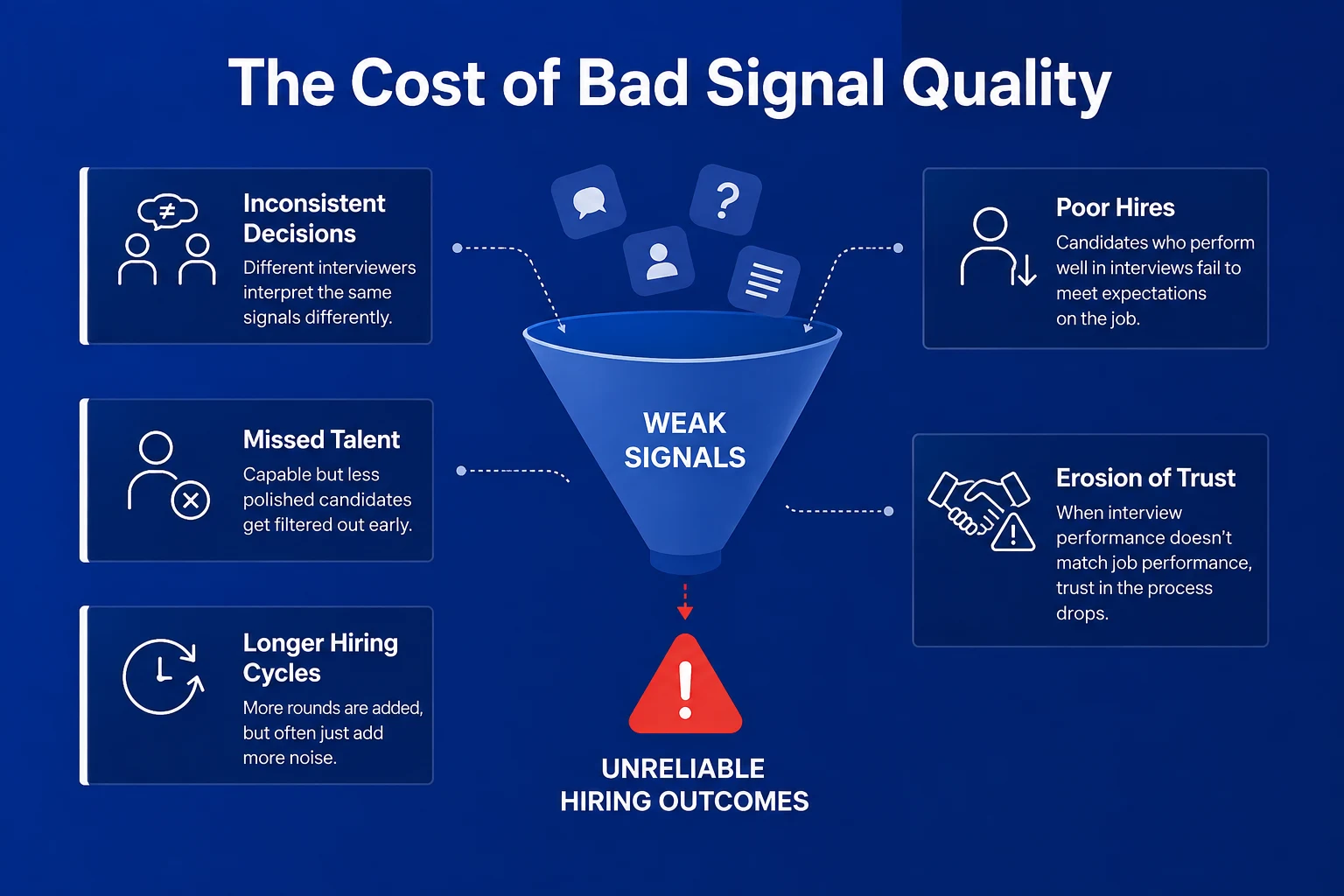
Weak signals do not just lead to occasional mistakes. They create systemic issues in hiring.
Inconsistent decisions: Different interviewers interpret the same signals differently. Outcomes vary widely.
Missed talent: Candidates who are capable but less polished get filtered out early.
Poor hires: Candidates who perform well in interviews fail to meet expectations on the job.
Longer hiring cycles: Teams add more rounds trying to increase confidence, but often just add more noise.
Erosion of trust in the process: When interview performance does not match job performance, confidence in hiring decisions drops.
At a high level, the problem is simple.
Interviews feel like a strong evaluation tool. But the signals they produce are partial, biased, and hard to verify.
And when you make high-stakes decisions on weak signals, the outcomes will always be unreliable.
How the system rewards rehearsal over real skill
Interviews are no longer just an evaluation process. They have become a game with clear patterns, known questions, and predictable expectations.
And like any game, the people who prepare for it specifically tend to win.
This creates a shift. Success in interviews starts to depend less on actual capability and more on how well someone has learned to navigate the format.
1. The rise of interview prep ecosystems
There is now an entire ecosystem built around cracking interviews.
Online courses that break down “perfect” answers
Frameworks for structuring responses, such as STAR, case templates, and product thinking models
Mock interviews that simulate real scenarios
Question banks with commonly asked problems and ideal approaches
Candidates are not just preparing for the role. They are preparing for the interview itself.
Over time, this leads to standardization. Answers start to sound similar. Approaches start to follow the same structure. Even mistakes become predictable.
Preparation becomes less about understanding fundamentals and more about recognizing patterns.
2. Pattern recognition over original thinking
Most interview formats reward familiarity.
If a candidate has seen a similar question before, they are already at an advantage. They know how to structure the answer, what points to hit, and how to guide the conversation.
This leads to a specific kind of performance:
Fast, structured responses
Clean articulation of steps
Confident delivery, even in ambiguous situations
But this is often pattern recall, not real-time thinking.
The candidate is not necessarily solving the problem from first principles. They may be mapping it to something they have already practiced.
In contrast, someone encountering the problem for the first time may take longer, explore more, and appear less “polished” even if their underlying thinking is stronger.
The system can end up rewarding the former.
3. Optimizing for clearing rounds
Once candidates understand how interviews work, their focus can shift.
The goal is no longer simply “be good at the job.”
The goal becomes “clear the interview.”
This changes behavior in subtle but important ways:
Emphasis on delivering answers in the expected format
Avoiding risks that could lead to uncertainty or mistakes
Steering responses toward what interviewers want to hear
Practicing delivery as much as, or more than, actual problem-solving
Candidates start optimizing for predictability.
They learn how to appear structured, how to signal ownership, and how to package their experience. Over time, this becomes a skill in itself.
But it is a different skill from doing the job.
4. The widening gap between interview and job performance
As preparation becomes more sophisticated, interview performance can improve without necessarily providing more evidence of how someone will perform in the role.
This creates a growing gap:
Candidates who look strong in interviews but struggle with real-world ambiguity
Teams that hire based on clean answers but face messy execution
Roles that require iteration, collaboration, and context, but are filled through isolated, time-bound evaluations
The better candidates get at interviewing, the more important it becomes to distinguish interview readiness from actual job readiness.
The New Risk: Authenticity and Interview Integrity
For a long time, one of the biggest problems with interviews was accuracy.
Now there is another problem: authenticity.
It is no longer safe to assume that the person you are evaluating is solving the problem independently, in real time.
The rise of AI has changed how candidates prepare for interviews, but it has also introduced new possibilities for real-time assistance. According to HireVue's 2026 Global AI in Hiring Report, 46% of candidates use AI to prepare for interviews. As AI tools become more accessible, the distinction between legitimate preparation and real-time assistance becomes increasingly important.
The interview is not just a weak signal. In some cases, it can become a manipulated signal.
1. AI-assisted answers in real time
Candidates no longer need to rely only on preparation. AI tools can provide real-time assistance during interviews, helping candidates generate, refine, or structure responses as questions are asked.
Coding solutions generated alongside the interview
Behavioral answers refined in real time
Case frameworks suggested instantly based on the question
This changes the nature of evaluation.
You are not just assessing the candidate’s thinking. You may also be assessing how effectively they can use external tools during the interview.
The output can still sound clean, structured, and confident.
But the source of that output is no longer clear.
2. External help is easier than ever
Candidates can use a range of AI-enabled and external assistance techniques during interviews. Understanding these candidate cheating techniques can help hiring teams recognize where traditional interview processes are vulnerable.
Candidates may also use:
Friends or coaches providing answers off-screen
Notes, prompts, or scripts placed outside the visible area
Second devices during remote interviews
Real-time guidance through chat or calls
None of this is necessarily visible in a standard interview setup.
From the interviewer’s perspective, everything may look normal. The candidate responds smoothly, thinks quickly, and rarely gets stuck.
But the performance may not be entirely their own.
3. Proxy candidates and impersonation
In some cases, the problem goes further.
The person giving the interview may not be the person who will actually do the job.
Examples can include:
Proxy candidates clearing technical rounds
Identity swaps between interview stages
Impersonation during remote assessments
Remote hiring has created new opportunities for these forms of interview fraud while making them more difficult to detect through conversation alone.
Without stronger identity and integrity checks, there is a risk of evaluating one person and ultimately hiring another.
The growing gap between what you see and what is real
This creates a new kind of gap.
Earlier, the gap was between interview performance and actual capability.
Now, there can also be a gap between what appears to be happening during the interview and what is actually happening behind the screen.
A correct answer may not reflect the candidate’s own thinking
A fast response may be externally assisted
A strong performance may not be repeatable without outside support
The interview still produces a signal.
But the integrity of that signal is now questionable.
Why traditional formats struggle here
Most traditional interview systems were not designed for this environment.
They generally assume:
The candidate is working independently
Responses are generated in real time
The person in the interview is the actual applicant
But these assumptions are increasingly difficult to take for granted in remote and AI-assisted hiring.
Adding more interview rounds does not necessarily solve the problem.
Asking different questions does not necessarily solve it.
Even experienced interviewers may struggle to identify external assistance through conversation alone.
Because the issue is not simply what the candidate says.
It is how that answer was produced.
As AI-assisted cheating evolves, hiring teams need to understand how AI is changing interview cheating and why traditional interview controls may no longer be sufficient.
What Modern Hiring Needs
Most hiring processes today run on a simple model: observe, assume, decide.
If a candidate answers confidently, they must understand the problem
If they describe past work clearly, it must be real
If they perform well in an interview, they will likely perform well on the job
For a long time, this worked well enough.
It does not anymore.
The problem is not just that interviews are imperfect. It is that the assumptions behind them are increasingly unreliable. Candidates now operate in environments where answers can be assisted, refined, or even generated in real time. What you see in an interview is no longer a clean reflection of individual ability.
This is where modern hiring needs to shift.
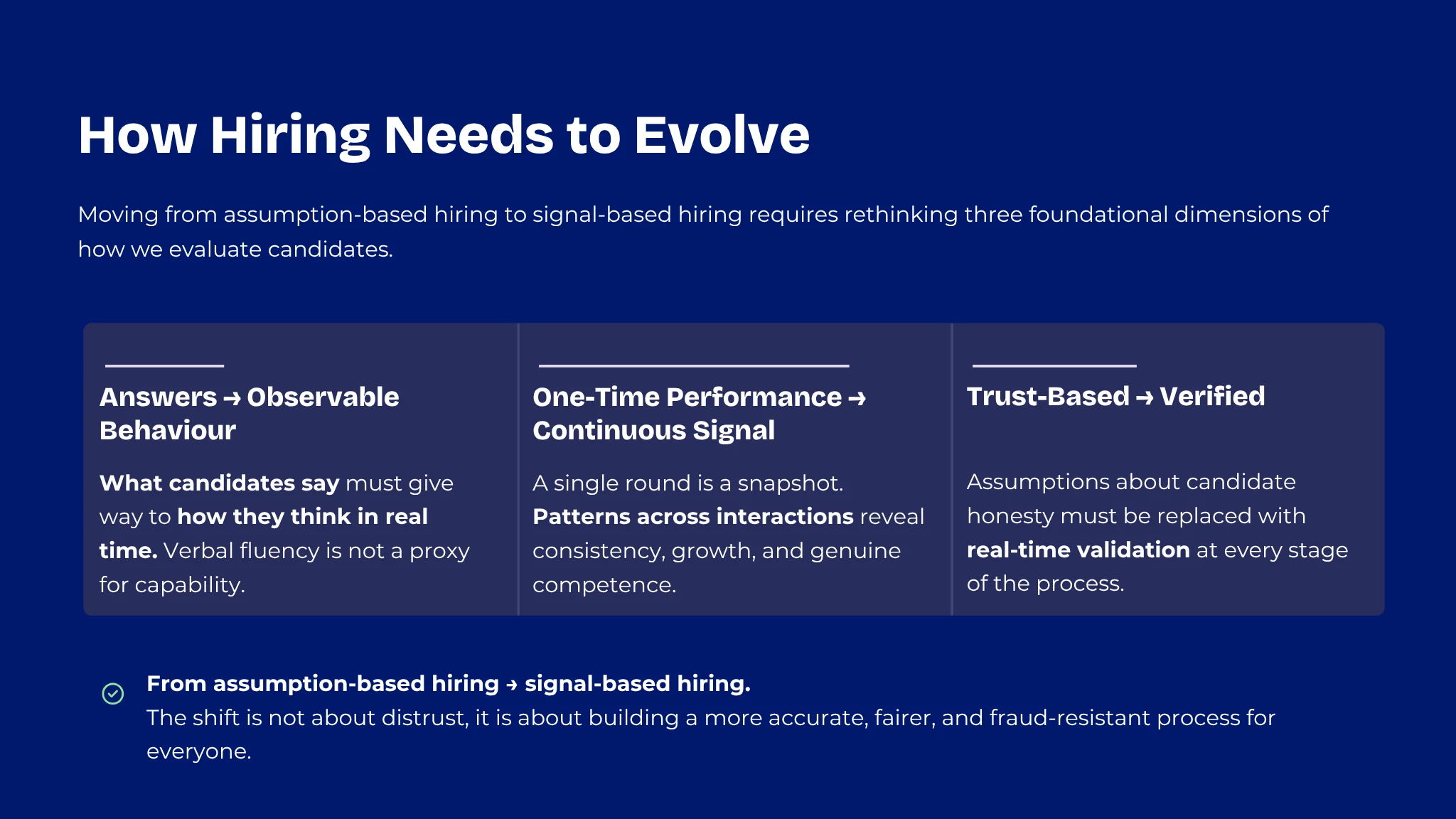
From answers to observable behavior
Traditional interviews focus heavily on answers:
“Tell me about a time…”
“How would you approach this?”
“Why did you make that decision?”
These are easy to prepare for.
Candidates can rehearse responses
Frameworks can structure answers in predictable ways
Delivery can be optimized with practice
As a result, answers often reflect preparation, not capability.
Observable behavior is harder to fake.
Instead of relying only on what is said, the focus shifts to what the candidate actually does:
How they break down a new problem
How they handle ambiguity without a clear path
How they respond when they get stuck
How their thinking evolves in real time
This gives a more direct signal of real ability, not just polished output.
From one-time performance to continuous signal
A typical interview captures a single moment.
One round
One interaction
One version of the candidate
But real ability is not a one-time event. It is a pattern.
Stronger hiring systems look for:
Consistency across multiple interactions
Ability to improve with context
Stability in how someone approaches different problems
This reduces reliance on outliers:
A candidate having a great day
A candidate underperforming due to nerves
An interviewer misjudging a single interaction
Instead of asking “Did they perform well once?”, the question becomes:
“Do they perform consistently?”
From trust to verification
Hiring has always depended on trust:
Trust that answers are independent
Trust that past experiences are accurate
Trust that the candidate is who they claim to be
Today, these assumptions are weaker.
Verification does not replace trust. It strengthens it.
It ensures:
The responses are genuinely coming from the candidate
The interaction is not being influenced externally
The person being evaluated is the actual applicant
Without verification, even strong interviews can produce misleading signals.
What better hiring signals should achieve
When hiring moves toward stronger, more observable signals, the benefits extend beyond simply identifying potential problems.
More consistent decisions: Interviewers have stronger evidence to evaluate.
Fairer evaluation: Candidates are judged on more than communication style and interview polish.
Fewer false positives: Strong interview performance can be evaluated alongside additional signals of independent ability.
Greater confidence: Hiring teams can make decisions with better visibility into what happened during the interview.
Most importantly, better signals help restore trust in the hiring process.
Modern hiring does not need to eliminate interviews.
It needs to make the signals produced by those interviews more reliable, observable, and trustworthy.
Restoring Trust in Interviews With Sherlock AI
Modern interviews are designed to answer a simple question:
Does this candidate actually have the skills they are demonstrating?
That question has become harder to answer as remote interviews, AI tools, and external assistance create new ways for interview performance to be influenced behind the scenes.
The challenge is not simply getting the candidate to give the right answer. It is getting enough reliable evidence to understand how that performance was produced.
More interview rounds do not necessarily solve this problem. Neither do better questions alone. Interviewers still have limited visibility into what is happening beyond the conversation.
Sherlock AI adds an integrity layer to the interview process, giving hiring teams additional signals about what is happening during the interview while keeping the final decision with the interviewer.
1. Add an Integrity Layer to Every Interview
Sherlock AI works alongside the existing interview process rather than replacing it.
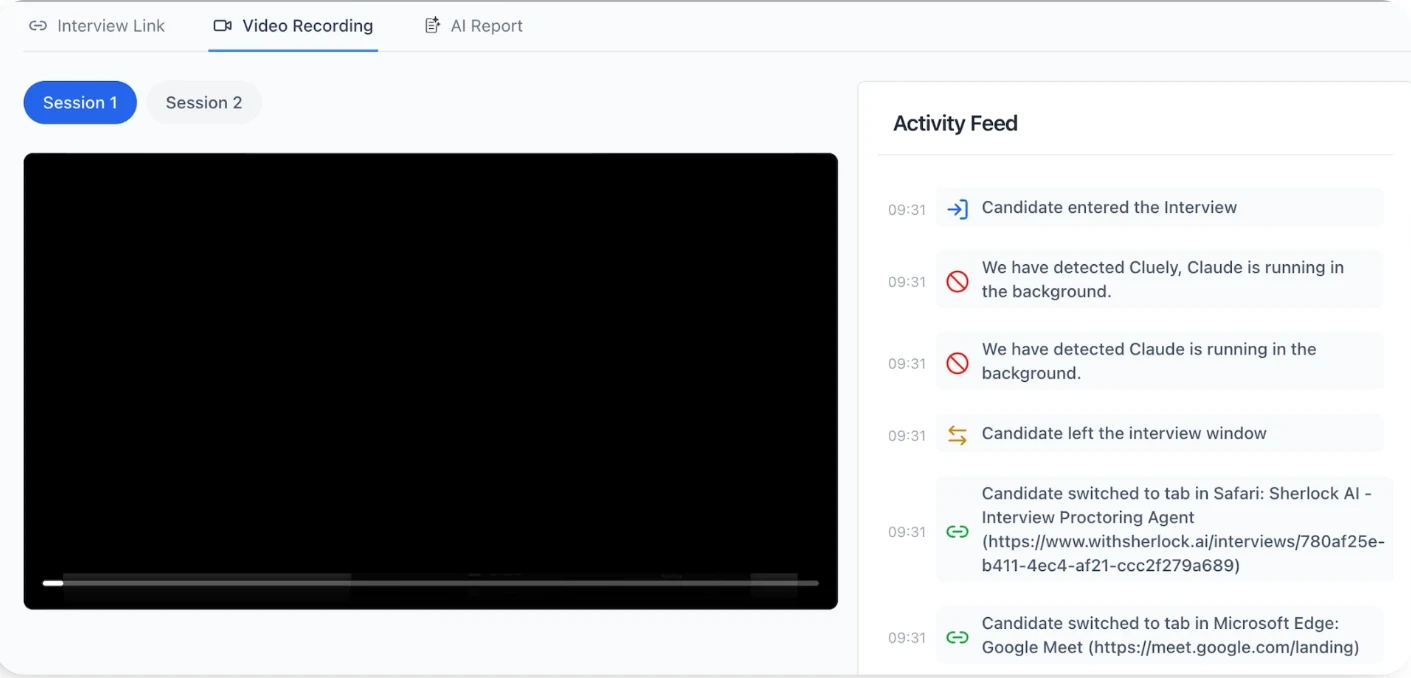
Instead of changing how interviewers evaluate candidates, Sherlock AI adds another layer of visibility around the interaction. It can analyze relevant video, audio, and device signals to surface patterns that may warrant further attention.
This can help hiring teams identify situations where the interview performance may not tell the whole story.
Sherlock AI can help surface signals related to:
Potential AI-assisted responses
Possible external assistance
Relevant device activity
Identity inconsistencies
Changes in behavior or response patterns
The goal is not to automatically label a candidate as dishonest.
The goal is to give interviewers more context before they make a high-stakes hiring decision.
The interview stays human. The visibility gets smarter.

2. Surface Signals Behind the Performance
A strong answer is useful evidence, but it does not always tell you how that answer was produced.
A candidate may respond with an unusually polished explanation, solve a problem quickly, or demonstrate knowledge that appears inconsistent with their earlier performance. These situations do not automatically mean misconduct, but they may justify a closer look.
Sherlock AI helps surface patterns that interviewers may want to investigate, including:
Potential AI assistance during the interview
Possible communication with external sources
Unusual changes in response or reasoning behavior
Inconsistencies across relevant identity, audio, video, or device signals
These signals are not a replacement for human judgment.
Instead, they help interviewers know when to ask a deeper question, revisit an answer, or validate a candidate's understanding independently.
3. Verify the Assumptions Behind the Interview
Traditional interviews rely on several assumptions:
The person being interviewed is the person who applied
The candidate is generating their responses independently
The performance reflects the candidate's own reasoning
The conditions of the interview are not materially influencing the evidence
Sherlock AI adds visibility around these assumptions.
Identity integrity: Surface signals that may indicate inconsistencies in the candidate's identity.
Response independence: Identify patterns that may suggest the candidate is receiving assistance during the interview.
Reasoning continuity: Give interviewers additional context when a candidate's reasoning or behavior changes unexpectedly.
This does not turn the interview into an automated pass/fail test.
Instead, it gives hiring teams another question to consider:
Is the performance we're seeing an authentic representation of the candidate's ability?
4. Turn Signals Into Better Interview Decisions
Detection is only useful if interviewers can act on the information.
Sherlock AI is designed to surface relevant signals during the interview so interviewers can investigate concerns while the conversation is still happening.
For example, an interviewer can:
Ask the candidate to explain their reasoning in a different way
Probe an unusually polished or unexpected response
Revisit an inconsistency immediately
Ask the candidate to demonstrate their understanding independently
Test whether the candidate can reproduce the same reasoning without external assistance
This creates a stronger feedback loop between detection and evaluation.
Sherlock AI does not decide whether a candidate should be hired.
It gives interviewers more information to make that decision themselves.
5. Move From Suspicion to Evidence
Without visibility, interviewers may be left with a vague feeling that something does not add up.
That creates two problems.
They may overlook genuine integrity concerns because there is not enough evidence to investigate. Or they may unfairly distrust a candidate based only on intuition.
Sherlock AI helps create a middle ground:
Assumption → Visibility
Suspicion → Signals
Signals → Investigation
Investigation → Better-informed judgment
The goal is not to make interviews more adversarial.
It is to make them more trustworthy.
Better Signals, Not More Interviews
The answer to modern interview integrity is not necessarily another interview round.
It is better visibility within the interviews you already conduct.
Traditional interviews tell you what a candidate said and how they performed in the moment. Sherlock AI adds another layer of context around that performance, helping hiring teams investigate potential integrity concerns without removing the human element from the hiring process.
The result is a hiring process where interviewers can spend less time wondering whether a performance is authentic and more time evaluating what actually matters:
Skills
Reasoning
Communication
Problem-solving
Independent performance
Because better hiring starts with better signals.
Conclusion
Traditional interviews are not failing because interviews are useless. They are failing because the signals they rely on are no longer strong enough. Candidates can receive external assistance, use AI tools, or present a level of performance that does not fully reflect their actual ability.
Hiring teams need more than convincing answers. They need greater visibility into how those answers are produced. Sherlock AI adds an integrity layer to live interviews, helping teams identify signals around identity, external assistance, and potentially AI-assisted performance while keeping human judgment at the center.
Interviews are not going away. They are evolving. With Sherlock AI, hiring teams can build more trustworthy signals, make more confident decisions, and evaluate candidates based on authentic performance.
Ready to make your interviews more trustworthy? Explore Sherlock AI and Schedule a Demo Today. |
|---|
Frequently Asked Questions
1. Why are traditional interviews becoming less reliable for evaluating candidates?
Traditional interviews often rely on self-reported experience, hypothetical questions, and short, high-pressure interactions. This can make communication, confidence, and interview preparation appear stronger than a candidate's actual ability.
2. How does interview preparation affect the accuracy of hiring decisions?
Candidates can prepare using question banks, frameworks, mock interviews, and rehearsed answers. As a result, strong interview performance may sometimes reflect familiarity with the interview format rather than real-time problem-solving ability.
3. How can AI affect interview integrity?
AI can potentially be used to generate or refine answers during an interview. Candidates may also receive assistance through secondary devices, external communication, or other tools, making it harder for interviewers to determine whether a performance is independently produced.
4. What is the difference between interview performance and job performance?
Interviews typically evaluate candidates under artificial constraints such as limited time, isolated problem-solving, and restricted access to tools. Real work is usually more iterative and involves collaboration, context, resources, and changing requirements.
5. How does Sherlock AI help improve interview integrity?
Sherlock AI adds an integrity layer to live interviews by providing additional signals around areas such as potential AI assistance, external assistance, identity inconsistencies, and changes in behavior or response patterns. These signals give interviewers additional context while keeping the final hiring decision with the human interviewer.
6. Does Sherlock AI automatically determine whether a candidate is cheating?
No. Sherlock AI is positioned as a source of additional signals rather than an automated pass/fail decision-maker. The signals can help interviewers investigate potential concerns, ask follow-up questions, and make a better-informed hiring decision.