
Back to all blogs
Learn how to detect OfferGoose in interviews, identify potential AI-assisted behavior, and prevent real-time AI cheating during remote hiring.

OfferGoose is an AI-powered interview copilot that can provide candidates with real-time assistance during job interviews. By generating suggested responses while an interview is taking place, tools like OfferGoose can make it harder for recruiters to determine whether an answer reflects a candidate’s own knowledge, experience, and reasoning.
For hiring teams, this creates a growing interview integrity challenge. A candidate may appear confident and well prepared while relying on external AI assistance to formulate responses in real time.
When candidates rely on AI in real time, recruiters may end up evaluating generated responses instead of actual ability. This creates a gap between perceived performance and real capability, making it harder to make informed hiring decisions. Cheating attempts in hiring assessments increased from 16% to 35% in one year, driven largely by AI tools. 39% of candidates use AI during the job application process, including generating answers for assessments and interviews.
So, can OfferGoose be detected?
Not reliably through a single visual cue or traditional screen sharing. Instead, recruiters should look for patterns across response timing, communication, reasoning, and behavior, and use interview techniques that make it easier to evaluate independent thinking.
In this guide, we explain what OfferGoose is, how it may be used during interviews, the signs that may indicate AI assistance, and how hiring teams can prevent OfferGoose from undermining interview integrity.
What Is OfferGoose?
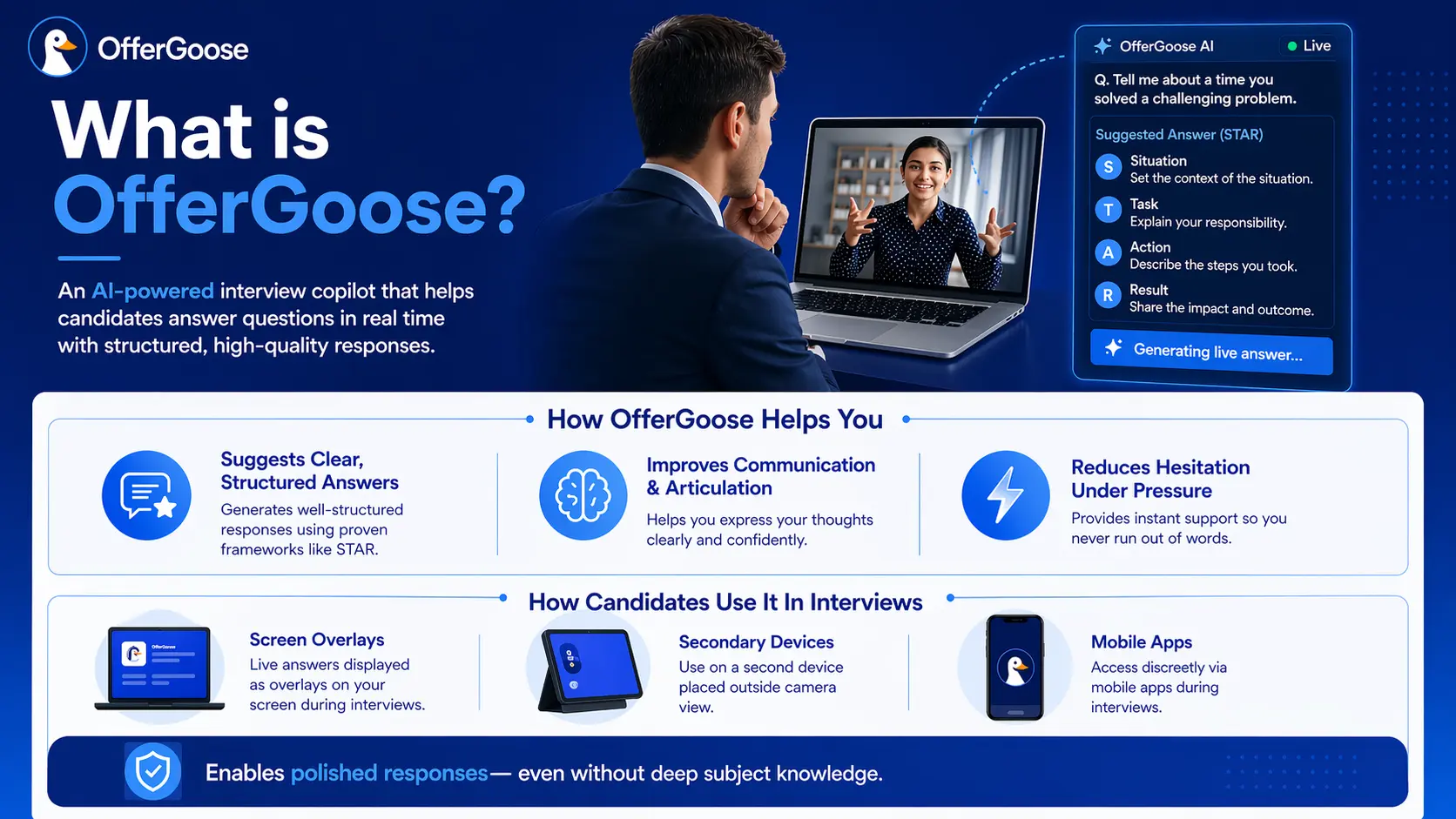
OfferGoose is an AI-powered interview copilot that helps candidates generate structured responses to interview questions in real time. It is designed to help users communicate more clearly, respond quickly, and handle interview questions with greater confidence.
The tool can provide AI-generated answers during a live interview, which creates a challenge for recruiters when real-time AI assistance is not permitted. Instead of evaluating a candidate’s unaided knowledge and reasoning, recruiters may unknowingly assess responses influenced or generated by an external AI tool.
How Candidates Use OfferGoose in Interviews
Candidates may access OfferGoose during an interview through different setups, including:
Screen overlays that display AI-generated responses
Secondary devices positioned outside the camera’s view
Mobile devices used during the interview
These methods can allow candidates to receive real-time assistance while maintaining the appearance of a normal interview interaction.
OfferGoose is one example of a broader category of AI interview copilots that can make it more difficult for hiring teams to determine whether a candidate is responding independently.
👉 OfferGoose is just one example. Discover how Cluely AI is being used in interviews and how to detect it effectively.
How Does OfferGoose AI Work?
OfferGoose AI works as a real-time interview copilot that listens to interview questions, processes them, and generates tailored response suggestions for the candidate. Its Formal Interview feature can use information from the candidate’s resume and job description to provide more relevant responses during the interview.
The process typically involves several steps:
1. Candidate Provides Their Resume and Job Description
OfferGoose can use the candidate’s resume and target job description to personalize the assistance it provides during an interview.
2. OfferGoose Captures the Interview Audio
The tool processes interview audio to identify what the interviewer is asking. Its documentation states that the Formal Interview feature recognizes interviewer questions in real time.
3. AI Processes the Interview Question
Once a question is identified, the AI analyzes it in the context of the candidate’s background and the role they are interviewing for.
4. OfferGoose Generates a Response
The system generates a tailored response or response guidance that the candidate can use while answering the interviewer.
5. Candidate Uses the AI Assistance in Real Time
The candidate can review the generated assistance and incorporate it into their response while continuing the live interview.
This real-time workflow allows an AI copilot to provide assistance without requiring the candidate to stop the conversation or manually search for an answer.
Learn more about How Recruiters Can Detect AI Copilot Usage in Interviews
Can OfferGoose Be Detected?
In many live interviews, OfferGoose can be difficult to detect using traditional interview methods alone. Standard video conferencing platforms such as Zoom, Google Meet, and Microsoft Teams are designed for communication, not interview integrity. They do not monitor background applications, analyze behavioral patterns, or identify AI-assisted responses during an interview.
Detection with Traditional Interview Methods
Traditional interviews primarily depend on the recruiter’s observations and follow-up questions. An interviewer may notice signs such as delayed responses, unnatural pauses, inconsistent technical explanations, or candidates frequently shifting their attention away from the screen. While these behaviors can raise suspicion, they are not definitive evidence that a candidate is using OfferGoose or another interview copilot.
As AI interview assistants become more sophisticated, relying solely on manual observation makes it increasingly difficult to distinguish between genuine candidates and those receiving real-time AI assistance.
Detection with Sherlock AI
Unlike standard interview platforms, Sherlock AI is built specifically to detect interview fraud and AI-assisted cheating. It continuously analyzes multiple signals throughout the interview instead of relying on a single indicator.
Sherlock AI helps identify the possible use of tools like OfferGoose by monitoring:
Background application activity
Behavioral and gaze patterns
Response timing and consistency
Device and environment signals
Suspicious interaction patterns
By correlating these signals, Sherlock AI provides recruiters with greater visibility into potential AI-assisted interview behavior while reducing false positives. This enables organizations to conduct fairer remote interviews, strengthen candidate verification, and protect the integrity of hiring decisions.
Why Is OfferGoose Difficult to Detect?
OfferGoose and similar AI interview copilots can be difficult to detect because they are designed to provide real-time assistance without necessarily disrupting the visible flow of an interview.
Unlike traditional forms of cheating, candidates may not need to leave the interview, stop communicating, or perform an obviously suspicious action. AI assistance can happen alongside the conversation, making it difficult for recruiters to identify through observation alone.
Several factors make OfferGoose particularly challenging to detect:
Real-time AI assistance: Candidates can receive suggested responses while continuing the interview naturally.
Limited visibility: External devices, secondary screens, or other setups may remain outside the recruiter’s view.
Screen-sharing limitations: Sharing one screen does not necessarily provide visibility into every device or activity used during an interview.
Natural-looking responses: AI-generated answers can be structured, relevant, and confident, making them difficult to distinguish from well-prepared responses.
Subtle behavioral changes: Potential AI assistance may only become apparent through patterns in response timing, attention, communication, or interaction.
Because of these limitations, identifying OfferGoose use requires more than simply watching the candidate’s screen or looking for one suspicious behavior. A combination of behavioral, technical, and environmental signals can provide a more complete picture of what is happening during the interview.
Can Zoom, Google Meet, or Microsoft Teams Detect OfferGoose?
No. Platforms such as Zoom, Google Meet, and Microsoft Teams are designed primarily for communication and collaboration, not interview integrity. While they provide features such as video, audio, screen sharing, and recording, they are not designed to detect AI interview copilots like OfferGoose or determine whether a candidate is receiving real-time AI assistance.

Read more: How to Detect Cheating in a Zoom Interview
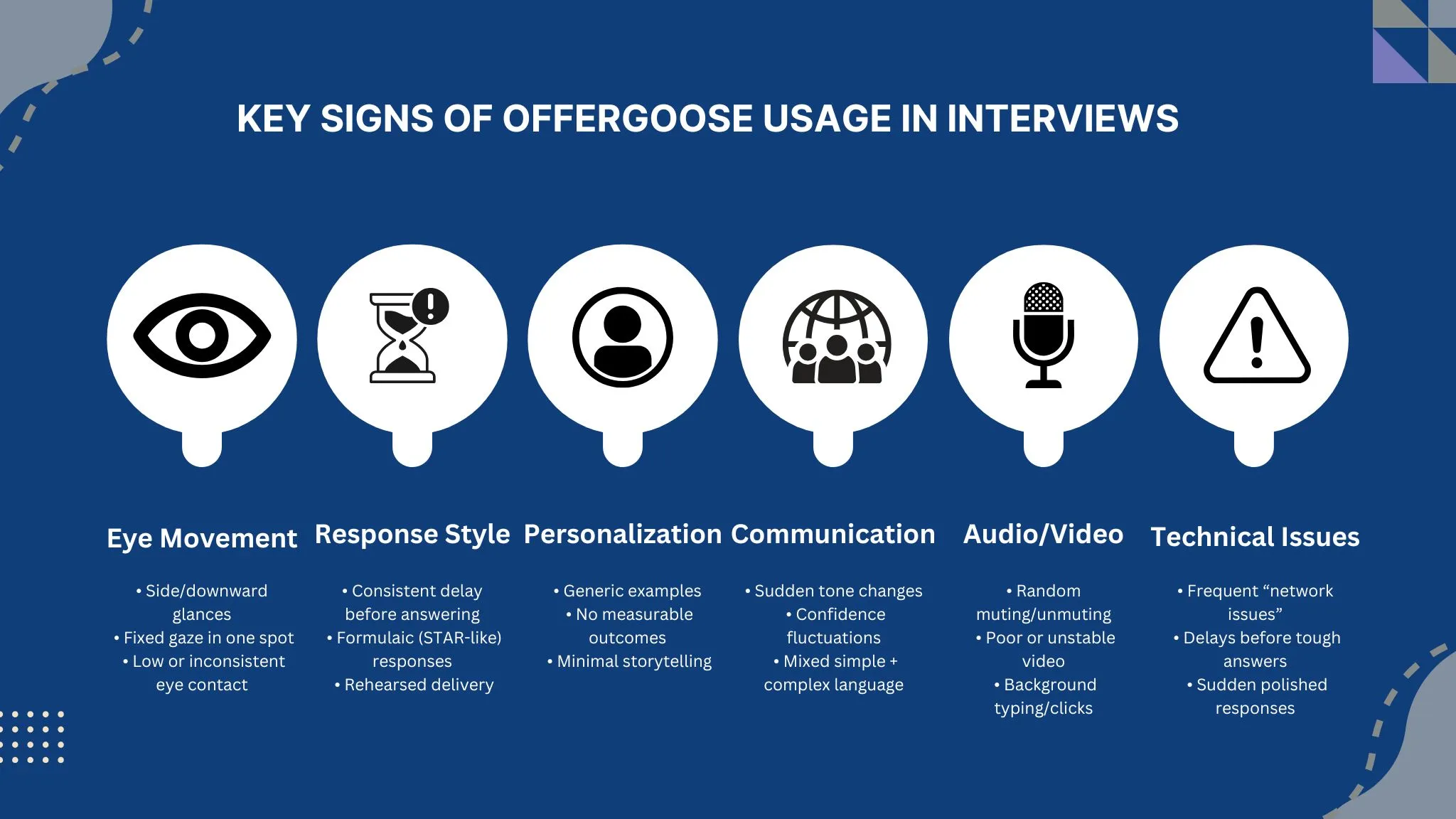
Key Signs of OfferGoose Usage in Interviews
Detecting OfferGoose requires recruiters to look beyond obvious cheating signals and pay attention to patterns in how candidates respond, communicate, and handle the flow of an interview. No single behavior proves that a candidate is using OfferGoose, but multiple unusual signals occurring together may warrant further review.
1. Unusual Eye Movement Patterns
Candidates receiving real-time AI assistance may repeatedly shift their attention toward the same area outside the interviewer’s view. While looking away from the screen is not evidence of AI use on its own, repeated and consistent attention shifts can be a signal worth examining.
What to watch for:
Frequent side or downward glances
Repeated attention toward a specific area
Changes in eye contact that coincide with difficult questions
2. Delayed but Highly Structured Responses
A candidate may pause noticeably before answering and then provide an unusually polished or highly structured response. Consistent delays followed by similarly structured answers may indicate that the candidate is receiving assistance before responding.
What to watch for:
Repeated delays before answering
Highly structured or formulaic responses
Sudden changes from conversational to overly polished answers
3. Lack of Personalization in Answers
AI-assisted answers can sound relevant and technically correct while lacking the personal details that demonstrate genuine experience. Candidates may struggle to provide specific examples, explain their individual contribution, or describe the reasoning behind a decision.
What to watch for:
Generic examples
Limited personal context
Difficulty explaining specific decisions or outcomes
4. Inconsistent Communication Style
A candidate’s communication style may change noticeably throughout an interview. Sudden differences in vocabulary, tone, confidence, or response structure can be worth reviewing, particularly when they occur alongside other signals.
What to watch for:
Sudden changes in speaking style or clarity
Noticeable fluctuations in confidence or pace
Shifts between simple and unusually technical language
5. Suspicious Audio or Video Behavior
Unexpected changes in audio or video behavior may provide additional context when assessing potential external assistance. These signals should be considered alongside other interview behaviors rather than treated as evidence on their own.
What to watch for:
Unexplained muting or unmuting
Fluctuating audio or video quality
Background typing, clicking, or delayed reactions
6. Conveniently Timed Technical Issues
Repeated technical interruptions during challenging questions may sometimes create additional time for a candidate to formulate a response. While genuine connectivity problems are common in remote interviews, a recurring pattern can warrant closer review.
What to watch for:
Repeated claims of lag or connectivity issues
Interruptions immediately before difficult questions
Unusual pauses followed by highly polished responses
No single signal confirms the use of OfferGoose. Recruiters should look for consistent patterns across multiple signals and consider the overall context of the interview before reaching a conclusion.
The Real Risk for Hiring Teams
OfferGoose can introduce a hidden layer into remote interviews. When candidates use real-time AI assistance, recruiters may believe they are evaluating the candidate’s own knowledge, reasoning, and communication skills when the responses are actually being influenced by an external hidden AI tool.
This can create several risks for hiring teams:
Mis-hires: Candidates may appear more capable than they are without AI assistance.
Inaccurate skill assessment: Recruiters may evaluate polished AI-assisted responses instead of genuine knowledge and reasoning.
Poor on-the-job performance: Candidates who relied heavily on AI during the interview may struggle when required to perform independently.
Increased hiring costs: Poor hiring decisions can lead to lower productivity, attrition, and additional recruiting costs.
Loss of trust: Undetected AI assistance can undermine confidence in the fairness and reliability of the interview process.
For organizations hiring at scale, even a small number of AI-assisted interviews can affect hiring quality and make it harder to identify candidates based on their actual capabilities.
Learn more about: How to Prevent Mobile AI Assistance During Interviews
Why Traditional Interviews Are No Longer Enough
Traditional interview methods were not designed to detect real-time AI assistance. Static question sets, predictable interview formats, and reliance on recruiter observation can make it difficult to determine whether a candidate is answering independently or receiving assistance from tools like OfferGoose.
As AI interview copilots become more sophisticated, recruiters risk evaluating polished AI-assisted responses instead of a candidate’s actual knowledge, reasoning, and communication skills.
Key Gaps in Traditional Interviews
Predictable question formats
Common and repetitive interview questions can be easily supported by AI-generated responses, making it harder to evaluate genuine candidate ability.Limited behavioral insights
Recruiters primarily rely on visible behavior and conversation, which may not reveal subtle patterns associated with external AI assistance.No real-time detection mechanisms
Traditional interview setups generally do not analyze response timing, behavioral patterns, or other signals that may indicate AI-assisted activity.
What Modern Hiring Requires
To identify potential AI-assisted interview behavior more effectively, hiring teams need to move beyond surface-level observation and adopt:
Adaptive interview frameworks that make responses less predictable
Behavioral intelligence to identify unusual patterns
Real-time signal analysis to provide greater visibility into potential AI assistance
This approach helps organizations evaluate candidates based on authentic performance while reducing the risk of making hiring decisions based on AI-assisted responses.
How Sherlock AI Helps Detect OfferGoose
Sherlock AI is purpose-built to detect AI-assisted interview cheating and other forms of interview fraud. It analyzes multiple signals throughout the interview to help hiring teams identify potential use of AI copilots like OfferGoose and review the evidence before making a hiring decision.
1. AI Copilot Detection
Sherlock AI identifies signals associated with hidden, real-time interview assistance from AI copilots. This helps recruiters detect potential use of tools like OfferGoose without relying solely on what is visible during the interview.
2. Second Screen & Device Detection
Candidates may use additional screens, phones, tablets, or other devices to receive external assistance during an interview. Sherlock AI analyzes signals associated with second-screen and device usage to help identify potential hidden assistance.
3. Behavioral & Attention Analysis
Sherlock AI analyzes behavioral signals such as eye movement, attention shifts, response timing, and changes in delivery patterns. By evaluating these signals together, it can surface patterns that may indicate external assistance rather than relying on a single behavioral cue.
4. AI-Assisted Answer Detection
Sherlock AI analyzes answer behavior, response patterns, and timing to identify potential signs of AI-assisted responses. This helps recruiters investigate whether a candidate's performance may have been influenced by real-time AI assistance.
5. Evidence-Based Interview Reports
Sherlock AI connects detected signals to specific moments in the interview, creating an evidence trail that recruiters can review. Instead of relying on a single risk score or isolated signal, hiring teams can examine the surrounding context before making a decision.
By combining AI copilot detection, device and behavioral signals, response analysis, and reviewable evidence, Sherlock AI gives hiring teams greater visibility into potential OfferGoose usage and other forms of AI-assisted interview cheating.
Final Thoughts
OfferGoose highlights a growing challenge for remote hiring: candidates can receive real-time AI assistance without it being obvious to the interviewer. Traditional interview methods, screen sharing, and manual observation may not provide enough visibility to identify potential AI-assisted behavior.
For hiring teams, the goal is not simply to identify one specific tool. It is to ensure that candidates are evaluated on their own knowledge, reasoning, communication, and problem-solving abilities.
Sherlock AI helps organizations detect potential AI-assisted interview cheating by analyzing multiple signals throughout the interview. By combining behavioral, device, interaction, and AI-assistance signals, Sherlock AI gives recruiters greater visibility into suspicious interview patterns and helps them make more confident hiring decisions.
Protect the integrity of your remote interviews with Sherlock AI. Book a walkthrough to learn how you can detect AI-assisted interview cheating. |
|---|
Frequently Asked Questions
1. What is OfferGoose?
OfferGoose is an AI-powered interview copilot that provides candidates with real-time assistance during interviews. It can help generate or suggest responses based on the interview question and the candidate’s background.
2. Can OfferGoose be detected during an interview?
Yes. Sherlock AI can help detect potential OfferGoose usage by analyzing multiple signals during a remote interview, including behavioral, device, interaction, and AI-assistance signals. No single signal should be treated as definitive proof of AI assistance.
3. Can Zoom detect OfferGoose?
Zoom is primarily a video conferencing platform and is not designed specifically to detect AI interview copilots such as OfferGoose. Screen sharing may provide visibility into a candidate’s shared screen, but it does not necessarily reveal activity on other devices or outside the shared screen.
4. Can Google Meet detect OfferGoose?
Google Meet is designed primarily for video communication and collaboration rather than interview-integrity monitoring. It does not provide dedicated detection for AI interview copilots such as OfferGoose.
5. Can Microsoft Teams detect OfferGoose?
Microsoft Teams provides video, audio, screen sharing, and collaboration features, but it is not specifically designed to detect AI-assisted interview cheating or tools such as OfferGoose.
6. How can recruiters detect OfferGoose usage?
Recruiters can look for multiple signals, including unusual response timing, repeated attention shifts, inconsistent communication patterns, and difficulty answering unexpected follow-up questions. Dedicated interview-integrity solutions such as Sherlock AI can analyze multiple signals together to provide greater visibility into potential AI-assisted behavior.
7. How can companies prevent OfferGoose cheating?
Companies can reduce the risk by establishing clear AI-use policies, using dynamic follow-up questions, testing independent reasoning, and using interview-integrity technology that can identify potential AI-assisted behavior.